What is a Chatbot? Artificial Intelligence and the “Agentic AI” Revolution That Ends Operational Chaos in E-Commerce
The AI revolution that ends operational chaos in e-commerce! Learn how to manage your sales 24/7 with the differences between chatbots and agentic AI, ROI analysis, and Instagram/WhatsApp automation.
28 min read
In this comprehensive guide, we delve into Agentic AI (Autonomous Agents), the new standard for the 2026 e-commerce world, and how it differs from the traditional Chatbot concept. For business owners and managers, you will discover a data-driven strategic roadmap that ends operational chaos, 100% automates "Where is my order?" inquiries, sells 24/7 via Instagram and WhatsApp, and maximizes your Return on Ad Spend (ROAS).
Executive Summary
As we enter 2026, the nature of commerce and customer communication is undergoing one of the most fundamental transformations in its history. The traditional "chatbot" concept has evolved from simple rule-based systems into "Agentic AI" (Autonomous Artificial Intelligence) systems capable of making complex decisions, acting autonomously, and actively managing sales processes. This report provides a deep analysis of the operational bottlenecks, increasing customer expectations, and declining profit margins faced by SMEs and Enterprise businesses, particularly in the Turkish market.
This document goes beyond the question of "What is a Chatbot?" and provides a response with academic depth and practical strategies to the question: "How can artificial intelligence transform my business into a sales machine?"
Section 1: The Evolution of Digital Communication and Redefining the "Chatbot" Concept
1.1. Terminological Confusion: Differences Between Chatbots, Assistants, and Agents
In the business world, the term "chatbot" is often misunderstood and identified with old-generation, inadequate technologies. However, the technology we are discussing in the 2026 vision is more of a "digital employee" than a piece of software. Academic literature and industry reports suggest examining these technologies in three main categories:
Agentic AI
Conversational AI
Rule-Based Bots
PEAK LEVEL
Decision Making & Task Execution & Sales
ADVANCED LEVEL
Understanding & NLU
STARTING LEVEL
Button-Based Only / Simple
1.1.1. Rule-Based Chatbots: The Legacy of the Past
These systems move along a predefined decision tree. They operate on an "If/Then" logic. If the user does not press a specific button or write a specific keyword like "return" exactly, the system stalls.
Meaning for Business: They are low-cost but risky for customer experience (CX). They force the user into narrow patterns and usually result in the frustration: "I want to speak to a human representative."
Visual Representation: Think of a flow chart; at each step, the user is offered only option A or B. Option C means the system crashes.
1.1.2. Conversational AI: The Era of Understanding
With the integration of Natural Language Processing (NLP) and Natural Language Understanding (NLU) technologies, chatbots have moved from word matching to "intent" analysis.
Capability: When a user says "I want to send the shirt back," "I will return this," or "Give me my money back," the system understands that all of these signify the same "Return Request" intent.
Context: It remembers the history of the conversation. If a customer first asks "Are there shoes?" and then "What is the price?", it knows the price refers to the shoes.
1.1.3. Generative AI and LLMs (Large Language Models): The Era of Creativity
The emergence of models like ChatGPT, Claude, and Gemini allowed chatbots to generate responses that were not pre-written.
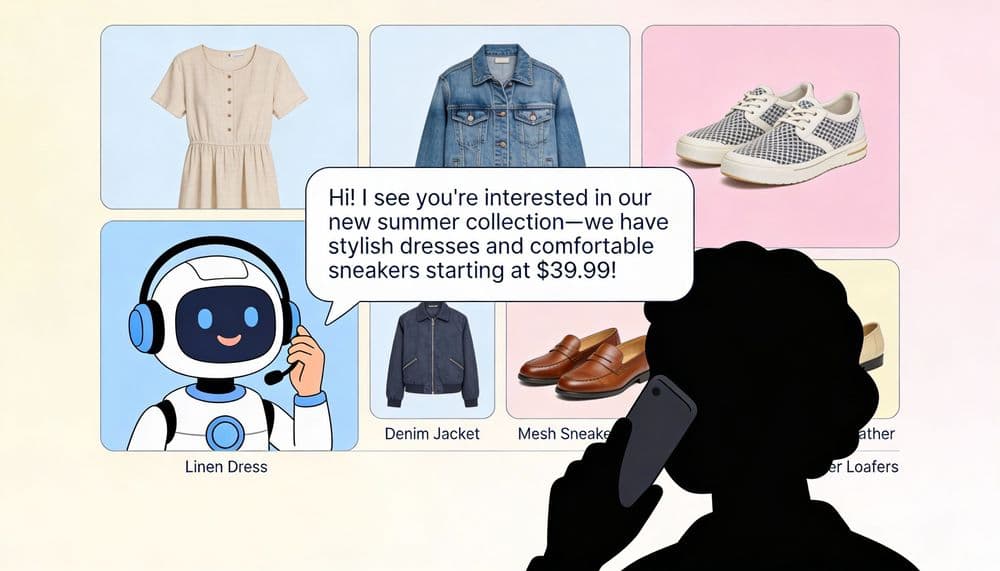
Revolution: An AI trained on thousands of product descriptions, blog posts, and return policies from an e-commerce site can act like a sales consultant. It can provide unique, context-appropriate answers such as, "Since the fabric of this dress is 100% cotton, it will keep you cool in summer; also, the blue color is currently in stock," even if this exact sentence isn't in the database.
1.1.4. Agentic AI (Autonomous Agents): The Standard of the Future
The focus of our report, representing the vision of Etkin.ai, is this level where AI transforms from just a talking entity into a task-executing one.
The Concept of Agency: An agent doesn't just answer a question; it autonomously creates a plan and uses tools to achieve a goal.
Example Scenario:
User: "My order is delayed, cancel it and refund my card."
Generative AI: "You can go to the My Account page for cancellation procedures." (Provides information)
Agentic AI: Connects to the CRM, checks order status, confirms via cargo integration that the package hasn't left, connects to the bank API to initiate the refund, and tells the customer, "I have completed your transaction and sent your receipt via WhatsApp." (Performs the task).
1.2. Historical Perspective: The Journey from ELIZA to Agentic AI
To appreciate today's technological capabilities, one must understand the road traveled. This evolution is proof of why "Ayşe Hanım" (a Manager) can now trust this technology.
1.2.1. 1966: ELIZA and the First Illusion of Dialogue
Developed by Joseph Weizenbaum at MIT, ELIZA imitated a Rogerian psychotherapist. It took keywords from the user's input and turned them into question forms.
User: "My boyfriend is treating me mean."
ELIZA: "Why is your boyfriend treating you mean?"
This system didn't actually understand what the user said; it just performed pattern matching. However, people felt that the machine was "listening" to them.
1.2.2. 1970s: PARRY and Paranoid Schizophrenia
Developed by Kenneth Colby at Stanford, PARRY went a step further by simulating someone with paranoid schizophrenia. PARRY didn't just respond; it had a "mood" and a "belief system." This was the first sign that chatbots could acquire a persona.
1.2.3. 2010s: Virtual Assistants (Siri, Alexa) and the Breaking Point
Apple's Siri (2011) revolutionized the consumer market in terms of Automated Speech Recognition (ASR) and understanding intent. However, these systems were "black boxes" and difficult for businesses to customize with their own data. E-commerce firms tried Facebook Messenger bots during this period, but because the technology wasn't yet mature, the user experience was problematic.
1.2.4. 2017 and the Transformer Revolution
The "Attention Is All You Need" paper published by Google researchers radically changed AI's language processing capacity. Instead of processing words sequentially, this structure focuses on the relationship between all words in a sentence (the attention mechanism), forming the basis for today's GPT models. Thanks to this, chatbots can sustain long and complex conversations without losing context.
Section 2: The Bleeding Wound of E-Commerce: Operational Chaos and Human Resource Crises
No matter how advanced technology becomes, it is meaningless if it doesn't solve a business problem. Analyses in Etkin.ai's "Persona Map" show that SMEs in the Turkish e-commerce market are experiencing a deep crisis. This crisis is "Operational Chaos," which increases in direct proportion to the increase in revenue.
2.1. "Invisible Labor" and Managerial Burnout
While e-commerce managers appear to be people making strategic decisions from the outside, 70-80% of their daily work involves "putting out fires."
Repetitive Questions: An average of 60-70% of messages arriving at an e-commerce store are questions like "Where is my cargo?", "What is the return code?", or "When will stock be updated?"—answers that are in the database but difficult for the customer to find.
Inefficiency Cycle: The manager or support team spends all day copying tracking numbers from the shipping panel and pasting them into WhatsApp. This is the most inefficient use of human intelligence. Ayşe Hanım feels exhausted at the end of the day but feels she has done nothing "strategic." This situation is called "Invisible Labor."
Distribution of Invisible Labor
AI can handle 70% of your operational workload on its own.
%70
Recurring QuestionsWhere is my package? Return code?
2.2. The Relationship Between Agencies and ROAS (Return on Ad Spend)
The biggest paradox in digital marketing is this: The more successful the ad, the higher the risk of operational collapse.
Scenario: The agency (Can Bey) creates a perfect Instagram campaign. Thousands of potential customers flood the site and the DM inbox.
Bottleneck: The business's support team (or Ayşe Hanım working alone) cannot handle this sudden traffic spike. Questions are answered 2-3 hours, sometimes 24 hours later.
Result: In e-commerce, a customer's impulse buying intent decreases by 10% for every minute they don't receive an answer. An answer coming 2 hours later goes to an indifferent customer. The ad budget was spent, clicks were received, but no conversion occurred. The agency is blamed for failure, yet the problem is operational.
2.3. The Boss's Search for "Peace"
For a business owner, technology is not a goal but a tool. Mehmet Bey is not interested in "how" AI works (Transformer architecture, NLU, etc.). He has only one question: "Will this system make me money and save me from answering customer messages at midnight?"
Risk Perception: Investing in the wrong technology is not just a loss of money, but also a loss of prestige. Therefore, promises like "Try for Free" and "No Setup Required" are critical door-openers for this persona.
Section 3: Solution Architecture: How Do Modern "Agentic AI" Platforms Work?
Modern platforms like Etkin.ai use a layered architecture to manage the chaos described above. This architecture works more like an integrated "Operating System" than a simple chatbot.
3.1. Omnichannel Perception Layer
The customer is no longer on a single channel. The same customer may DM on Instagram in the morning, write to live support on the website at noon, and reach out via WhatsApp in the evening to ask about order status.
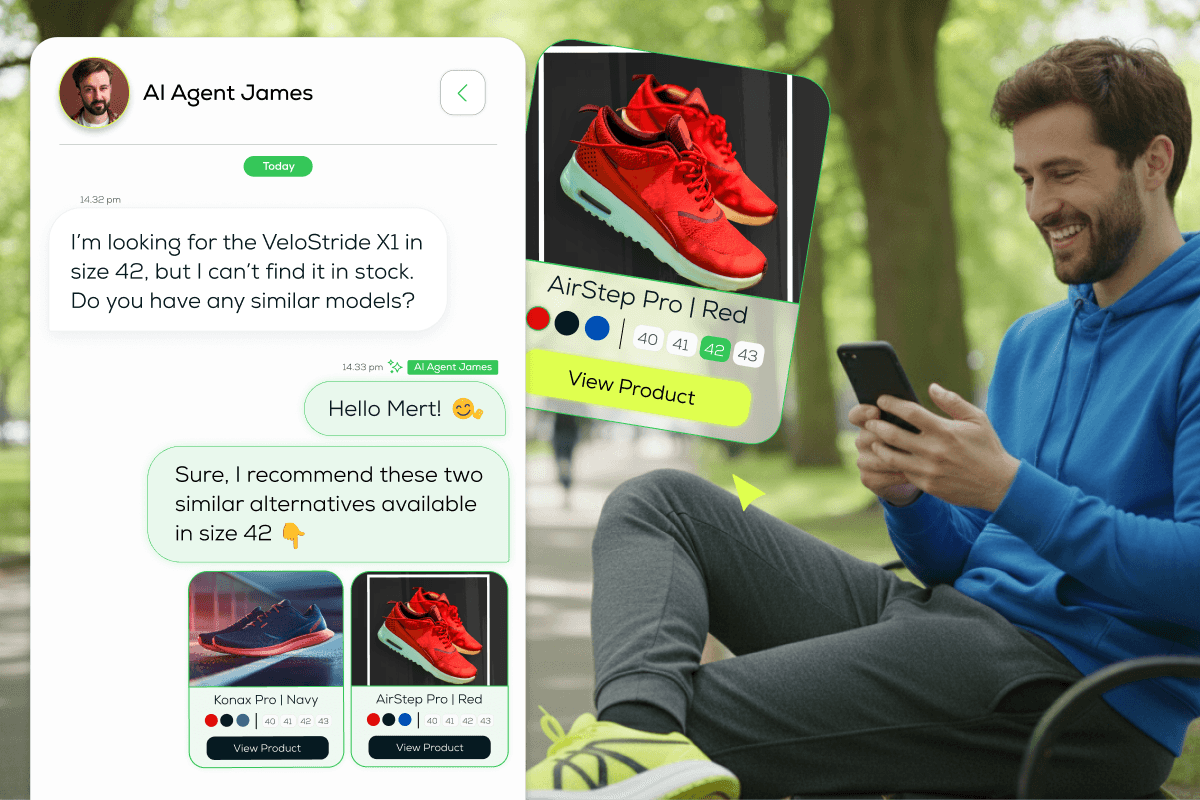
Unified Inbox: Agentic AI gathers all these channels into a single brain. By matching the Instagram username with the WhatsApp number (thanks to CRM integration), it has the memory to say, "Hello Ayşe Hanım, are you writing about the red dress you asked about on Instagram this morning?"
3.2. Reasoning Engine (The Brain)
This is where Large Language Models (LLM) operate. However, unlike a raw ChatGPT, it is equipped with business-specific "Guardrails."
Persona Design: The system is coded as "You are a sincere, helpful, but not over-familiar style consultant who has worked in the fashion industry for 20 years." It adopts the brand identity, from emoji usage frequency to the form of address (formal/informal).
Hallucination Control: The biggest risk for e-commerce is AI claiming a non-existent discount or stock (Hallucination). To prevent this, RAG (Retrieval Augmented Generation) technology is used. Before responding, the AI always queries the business's current database (PIM, ERP) and builds the answer only on these real facts.
3.3. Action Layer (Execution and Integration)
This is the layer that separates Agentic AI from a "Chatbot."
Etkin.ai Central System Flow
Manage requests from all channels in one center, automate operational processes.
Inputs (Channels)
Instagram
DM & Comments
WhatsApp
Business API
Web Chat
Live Support Widget
Etkin.ai Agentic Brain
Outputs (Actions)
Order Created
E-Commerce Integration
Cargo Info Provided
Real-Time Tracking
Appointment Booked
Calendar Sync
API Economy: The system is connected via API (Application Programming Interface) to e-commerce infrastructures like Shopify, Ticimax, İkas, T-Soft, Trendyol; to cargo companies like Yurtiçi, Aras, MNG; and to accounting programs like Akınsoft, Paraşüt.
Autonomous Operations:
Customer asks "Where is my cargo?".
AI understands the intent.
It pulls the customer's last order number from the database.
It queries the cargo company's API.
It receives the "Out for Delivery" info.
It informs the customer: "Your order will be delivered today, the courier at the branch is in contact."
This whole process takes 0.5 seconds and requires no human intervention.
Section 4: Critical Technology for the Turkish Market: "Voice Assistant" and "Outbound Calling"
While written communication (Chat) covers a large volume, voice is still king in critical moments of commerce in Turkey that require a "human touch." However, traditional call centers are expensive, cumbersome, and unscalable.
4.1. Speed to Lead: Calling Within Seconds
The speed of response to a customer who fills out a "Get Information" or "Request a Quote" form on a website is the most important factor determining the sale.
Statistics: If a lead is contacted within the first 5 minutes, the chance of reaching them increases by 900%. After 30 minutes, this chance drops to 10%.
Etkin.ai Voice Agent: The moment the customer clicks the submit button, the AI is triggered. It takes the customer's name and the product they are interested in from the CRM and calls them within seconds.
Experience: A customer who encounters a "Warm Touch"—a voice saying, "Hello Ahmet Bey, you just filled out a form for product X on our site. I called immediately to assist you, are you available?"—is surprised and impressed. This AI voice features human intonation, breathing, and pauses.
AFTER 30 MINRESPONSE
5%
CHANCE OF SALE
WITHIN 5 MINRESPONSE
900%
SALE INCREASE
As speed increases, the chance of sale increases exponentially.
4.2. Inbound Call Management: Ending the Queues
During campaign periods (Black Friday, 11.11), e-commerce site phone lines get locked. Customers wait on the line for 20-30 minutes and usually hang up to go to a competitor.
Unlimited Capacity: The AI voice assistant can answer even 1000 simultaneous incoming calls "without waiting."
Filtering: 80% of callers are saying "Where is my cargo?". The AI solves these simple questions. It forwards the remaining 20% of complex and emotional calls, like "My product arrived damaged, I'm very upset," to a human representative. Thus, human resources are used only where they are truly needed.
Section 5: Data and Analysis: Insights Provided by AI
Chatbots don't just talk to the customer; they also "listen" to them and transform this data into business intelligence. They offer insights at a depth that cannot be obtained through traditional methods (surveys, etc.).
5.1. Sentiment Analysis Map
AI scores the emotional state of customers' conversations.
Example Report: "Last week, 60% of customers displayed 'Anger' when using the word 'Cargo'." This data tells the manager that there is a problem with the cargo company and urgent intervention is required. Detecting the problem before the customer complains ensures proactive management.
5.2. Sales Funnel Analysis
AI analyzes at which stage conversations get stuck.
Detection: "40% of users stop the conversation after asking the price."
Action: This data shows there is an issue with the pricing policy or the presentation of the product's value proposition. Perhaps the chatbot should be retrained to explain the product's advantages better before stating the price.
Section 6: Social Commerce: Instagram and WhatsApp Automation
The heart of e-commerce in Turkey beats on social media. Instagram is not just a showcase but also a marketplace. WhatsApp has become almost the "official communication channel" in Turkey.
6.1. Instagram DM Automation: From Comment to Sale
When a user writes "Price?" under a product post, the AI detects this.
Public Reply: It writes "I've sent detailed information via DM 😊" under the comment (increases engagement).
Direct Message (DM): It sends the product link, stock information, and a special discount code if available to the user via DM.
Follow-up: If the user doesn't click the link, it makes a polite reminder 2 hours later: "Is there anything on your mind?". This process completely automates the "comment -> DM -> site -> sale" funnel.
6.2. WhatsApp Business API and the "Green Tick" Trust
WhatsApp API provided through official partners (BSPs) like Etkin.ai grants businesses "Verified Business" (Green Tick) status.
Campaign Management (Broadcasting): In compliance with KVKK (Personal Data Protection Law), personalized campaign messages can be sent to the opted-in database. A message like "Ayşe Hanım, the new filters that go great with the coffee machine you bought last month have arrived, would you like to buy them with a 20% discount special for you?" has a 98% Open Rate. Compared to email's 20% open rate, this is an enormous power.
Section 7: Implementation Strategy: "Trojan Horse" Tactics and Integration
A business's transition to AI is not a technical challenge but a strategic decision. A step-by-step roadmap should be followed to alleviate the concerns of the "Boss" and "Manager" in our persona.
7.1. Ease of Setup and Integration
Traditional software projects take months. Modern AI platforms, with their "No-Code" structure, are set up in minutes.
Step 1: The business enters its website address (URL) into the system.
Step 2 (Crawling): The AI crawls the site, learning all products, policies, and FAQs.
Step 3 (Test): When the business owner enters the panel and asks "How much is the shipping fee?", the AI answers "Shipping is free for orders over 500 TL" using information learned from the site's "Delivery Terms" page.
Step 4 (Live): The widget is added to the site with a single line of code, or the WhatsApp number is connected.
7.2. Cost and ROI Analysis
AI investment is a "savings" item, not an "expense."
Traditional: The cost of a customer representative (Salary + Insurance + Food + Transport + Equipment) is roughly 30-40 thousand TL per month. And this person can only work 8 hours a day, gets tired, and makes mistakes.
Artificial Intelligence: With a subscription of a few thousand TL per month, you have a "super employee" who works 24/7, answers thousands of people simultaneously, never gets tired, and never gets sick.
Operational Efficiency and ROI Comparison
AI is not just a saving tool, but an operational lever.
CRITERIA
HUMAN STAFF
AI SALES AGENT
💰 Cost
✕
High Fixed Expense Salary + Insurance + Food + Benefits
✓
Flexible & Affordable Low Monthly Subscription Model
🕒 Working Hours
✕
8 Hours a Day Weekends, holidays, and leave constraints
✓
24/7 Continuous Working 365 days a year without pause
⚡ Speed & Capacity
✕
Slow & Limited Communication with one customer at a time
✓
Instant & Unlimited Responses to thousands in seconds
Section 8: Future Vision and Ethical Considerations
In 2026 and beyond, Human-AI Collaboration will become the norm.
8.1. Hybrid Model: Where Is the Human Going?
AI will change people's job descriptions rather than taking their jobs away.
Human's Role: Tasks requiring empathy, complex problem solving, creative campaign design, and VIP customer relationship management.
E-commerce manager Ayşe Hanım will no longer be an "order tracking clerk," but a "customer experience architect."
8.2. Data Security and KVKK
Compliance with the Personal Data Protection Law (KVKK) in Turkey is critical. Local solutions (like Etkin.ai) provide advantages over global competitors (raw ChatGPT, etc.) regarding keeping data on servers in Turkey or using KVKK-compliant encryption protocols. Processes such as processing customer data and presenting explicit consent texts within the chat should be automated.
Tables and Data Visualizations
Table 1: Comparative Analysis of Communication Channels
Feature
Email
SMS
Traditional Call Center
AI Chatbot / Voice Agent
Open Rate
15-25%
90%+
-
98% (WhatsApp)
Response Time
Hours/Days
-
5-20 Min Wait
< 30 Seconds
Interaction
One-Way
One-Way
Two-Way (Live)
Two-Way (Autonomous)
Cost
Low
Medium
Very High
Low/Medium
Scalability
High
High
Low
Unlimited
Customer Feel
Formal/Cold
Informational
Tiring
Natural/Instant
Table 2: AI Impact in the E-Commerce Funnel
Funnel Stage
Traditional Problem
AI Solution
Expected Impact
Awareness
Traffic from ads goes unanswered.
24/7 Instant Greeting (Instagram/WhatsApp).
ROAS Increase
Interest
Late response to product questions.
Instant product/stock info and suggestions.
Time on Site Increase
Decision
Price/Shipping concerns.
Personalized discounts and reassuring answers.
Add to Cart Rate Increase
Purchase
Abandonment at the payment step.
WhatsApp reminders for products left in the cart.
Cart Abandonment Rate Decrease
Loyalty
Post-sales indifference.
Proactive cargo notification and "did you like it?" survey.
LTV (Lifetime Value) Increase
Conclusion: Time to Take Action
Chatbots and AI assistants are no longer "technology of the future" but a "requirement for today's competition." In the e-commerce world, speed is everything. The brand that is there at that "micro-moment" when a question hits the customer's mind wins the sale.
For bosses, this technology means a business that makes money even while they sleep. For managers, it means escape from chaos and prestige. For agencies, it means insurance that guarantees customer success.
In Turkey's dynamic market, collaborating with platforms like Etkin.ai, which understand local dynamics, have advanced Turkish language processing capabilities, and possess "Agentic" abilities, will determine the difference between surviving and becoming the market leader in 2026.
Transform Your Brand with Agentic AI
Take the first step now to end operational chaos and automate your sales.