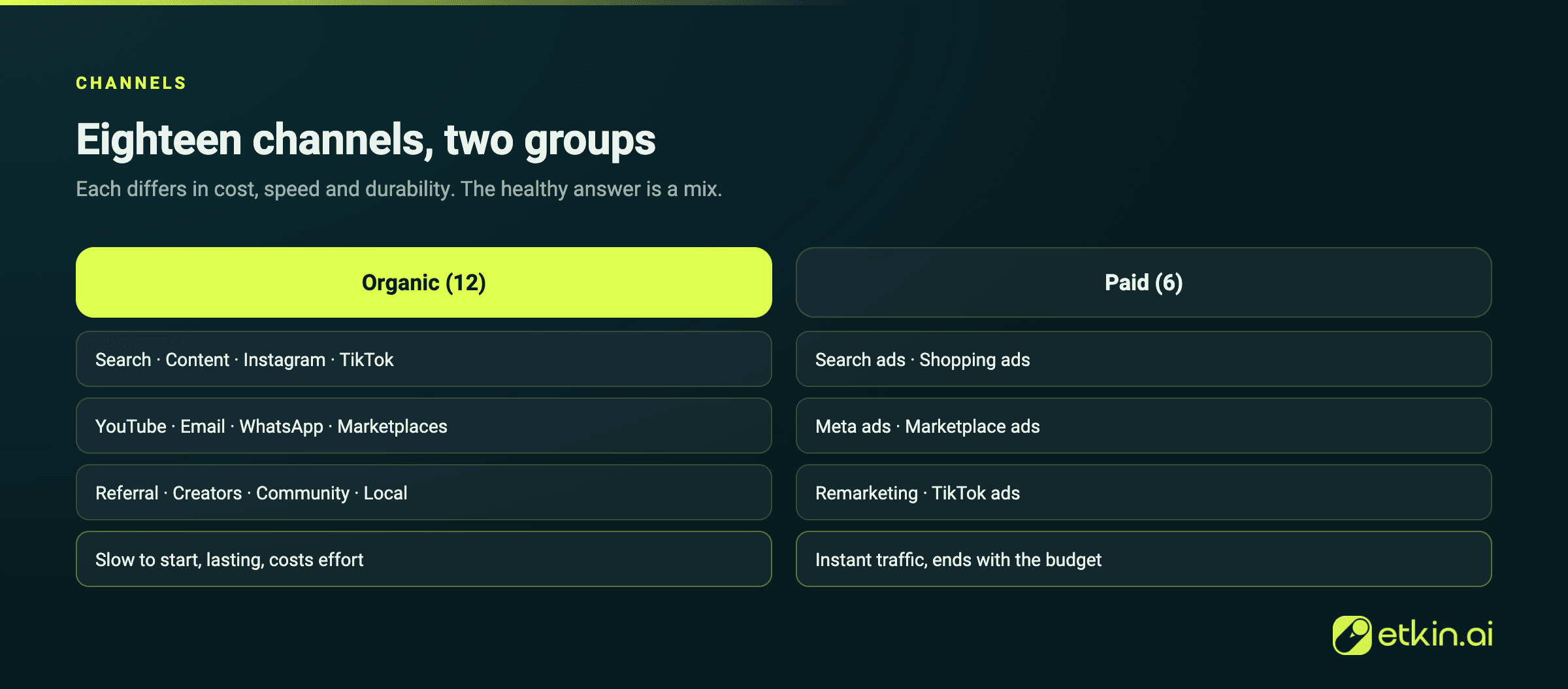
This is the question every new e-commerce brand asks: how do people actually find the site? There is no single magic channel. Channels split into two large groups, and each differs in cost, speed and durability. Let us set the logic first, then go through all 18.
Know one thing from the start: bringing traffic is half the job. If the visitors who arrive do not convert, more traffic simply means more loss. This article brings the traffic. To turn it into sales, read 25 methods to increase e-commerce sales as well.
Organic or paid?
| Organic channels | Paid channels | |
|---|---|---|
| Cost | Effort and time, low budget | A continuous ad budget |
| Speed | Slow to start, grows over time | Traffic immediately |
| Durability | Lasting; works as long as the content stands | Traffic ends when the budget does |
| Best for | Long-term, solid growth | Fast tests, campaigns, launches |
The healthy answer is a mix of both. A brand depending only on paid channels is left with no traffic the moment budgets are cut. A brand depending only on organic grows painfully slowly in the early months. The right move is to learn quickly with paid while building organic into a solid foundation over time.
Organic channels (they cost effort, not budget)
1. Search. Your customer should find you while looking for your product. Build product and category pages around the right words, fast and mobile-friendly. Search starts slowly but becomes the cheapest and most durable traffic source you have.
2. Content and blog. Write the answers to the questions customers ask before buying ("how do I choose", "which one suits me"). It brings search traffic and builds the trust that makes selling easier. The article you are reading now is an example.
3. Instagram. The strongest organic channel for visual products. Posts, stories, reels and selling through DMs. A serious share of e-commerce runs through Instagram DMs.
4. TikTok. Fast reach through short video. The right content can reach a wide audience even with few followers, which makes it powerful for brands selling to younger buyers.
5. YouTube. Demonstration, usage and comparison videos. It brings viewers who are inclined to buy, and the content keeps being watched for years.
6. Email. Your permission-based list costs nothing and belongs entirely to you. New product, restock and campaign announcements produce steady revenue. To grow the list, add a newsletter signup and a small incentive on the site.
7. WhatsApp. A channel that reaches opted-in customers directly, with very high open rates. Campaign and restock announcements get read here more than in email. As volume grows this channel becomes hard to run by hand; an AI assistant can send the permission-based campaigns and answer the incoming replies instantly.
8. Marketplaces. Enormous storefronts with their own traffic. Ranking depends not only on price but on your response speed and store rating. Visibility here brings both sales and recognition.
9. Referral and word of mouth. A happy customer is the cheapest and most trusted source of new customers. A simple "bring a friend, you both win" structure accelerates organic growth.
10. Partnerships and creators. Product collaborations with smaller creators whose audience overlaps with yours deliver quality reach without a large ad budget.
11. Communities and forums. Genuinely helping people in groups related to your sector builds trust and traffic over the long run. Contribute rather than sell.
12. Local visibility. For brands with a physical presence or a local service, appearing on maps and in local search brings customers who are ready to buy.
Paid channels (instant traffic, continuous budget)
13. Search ads. You appear in front of someone actively looking for your product. This is the audience closest to buying.
14. Shopping ads. Ads that appear in search results with your product image, price and store name. One of the most directly converting formats for e-commerce.
15. Meta ads (Instagram, Facebook). Reaches a wide audience through visual and interest targeting, and is strong for discovery. But without something to handle the flood of messages that follows, the budget can go to waste.
16. Marketplace ads. Ads inside marketplaces push your product to the top for users already in buying mode.
17. Remarketing. Appearing again in front of someone who browsed and left without buying. One of the most efficient paid tactics, because you are addressing someone who already knows you.
18. TikTok ads. Fast-growing reach in short video form, suited to brands with strong visual content selling to younger audiences.
Which channel should you start with?
Do not open them all at once; your resources will scatter. Choose by stage.
- New brand, low budget: one or two organic channels (Instagram and a marketplace, or search) plus a small remarketing budget. Learn what works first.
- A brand with traffic that wants to grow: double down on the two channels producing the most sales, and test one new channel in a controlled way.
- A brand growing in volume: balance paid channels with organic assets (search, content, email) so dependence on budget falls.
The golden rule: choose channels by whether the people arriving are genuinely buyers, not by volume. A channel that delivers crowds but never sells is more expensive than one delivering a few high-quality customers. To fit channel priority into a plan, see how to build an e-commerce growth strategy.
You brought the traffic. What if it does not convert?
This is where channel budgets most often go to waste. Most of the visitors you bring, whether through ads or organic effort, ask a question before buying: "will this fit me", "when will it arrive", "is it in stock". If that question goes unanswered, the traffic you paid for is lost.
On message-heavy channels like Instagram and WhatsApp especially, launching ads produces a flood that locks up the team. Replies slow down at exactly the moment the most customers are arriving, and messages that come at night or at weekends usually go unanswered entirely.
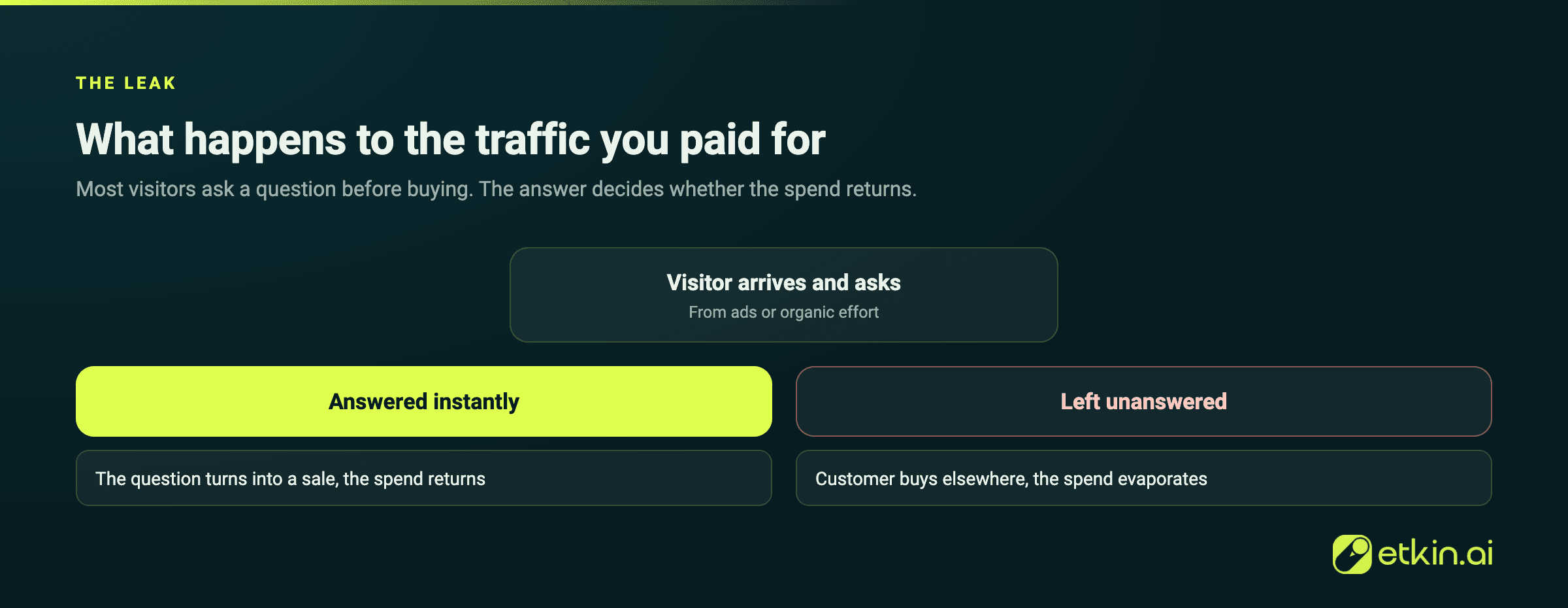
At Mervellion, more than 800 DMs arrive every day. Keeping up by hand at that volume is impossible; once 89% of messages were answered without a human touch, nothing went unanswered even on the busiest day, and the traffic from advertising stayed in the funnel. This is exactly what Etkin AI does: it meets messages on WhatsApp, Instagram and website chat around the clock, in the brand's own voice, using real stock and pricing data. It answers the question, recommends products and carries the customer to a sale, so the money you spend on channels does not evaporate.
In short: not leaving the traffic you attracted unanswered is as much an acquisition job as attracting it.
Frequently asked questions
Is it possible to get customers for free? Yes, through organic channels: search, content, Instagram and TikTok, permission-based email and WhatsApp, marketplace visibility and referrals. They need no ad budget, but they do need effort and time, and in return they become a lasting traffic source.
Which channel brings customers fastest? Paid channels deliver traffic immediately, and the ones closest to purchase are search and shopping ads plus remarketing. But traffic ends when the budget does, so balance them with organic channels.
How many channels should I start with? Two or three. Spreading across all of them splits your resources and you never master any. Be strong first on the two that bring you the best customers.
I cannot keep up with Instagram messages. What should I do? When message volume exceeds the team, sales slip away. Build something that meets incoming DMs instantly around the clock; an AI assistant can answer without delay and carry them to a sale, so traffic from advertising is not wasted.
Should I sell on a marketplace or on my own site? They feed each other. A marketplace gives you ready traffic and recognition; your own site gives you customer data and the ability to sell again. For most brands the right answer is both.
Read next
- How to Increase E-Commerce Sales: 25 Proven Methods
- How to Build an E-Commerce Growth Strategy
- More Traffic or Higher Conversion? Which One to Fund First
If you do not want the traffic you paid for to disappear into unanswered messages, let us show you in 15 minutes what Etkin AI does for your brand, using your own channels and your own data. Get started