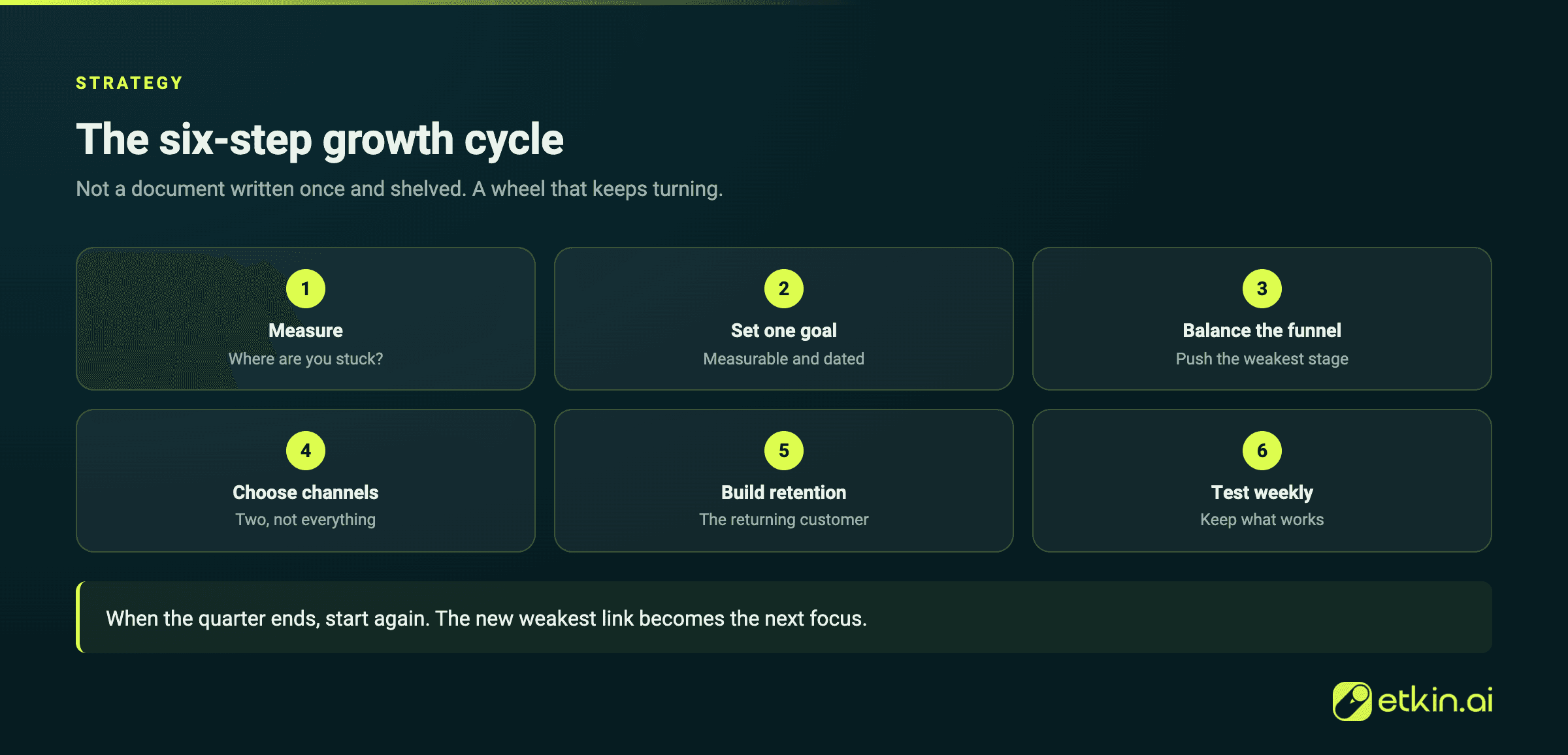
A brand without a growth strategy jumps to something new every week. One week a discount, the next a new ad campaign, the week after a channel it has never tried. Energy scatters, nothing gets measured, and results are left to luck. The good news is that growth settles into a six-step routine. First you measure where you are stuck, then you set a single goal, balance the four stages of the funnel, choose the right channel, build retention, and measure and test every week. This is not a document written once and shelved. It is a wheel that keeps turning.
Let us name the most common mistake up front: reducing strategy to "let's advertise more". Advertising feeds only the top of the funnel. While conversion, basket and repeat purchase are weak, most of the traffic you bring drains away. A strategy that works finds the weakest link first and pushes there.
Step 1: Measure and see where you are stuck
No strategy is built without knowing where you stand. Put four numbers in front of you.
| Metric | What it tells you | How to find it |
|---|---|---|
| Monthly visits and source split | Is traffic sufficient, is it tied to one channel | Your analytics panel |
| Conversion rate | Do arriving visitors turn into sales | Orders divided by visits |
| Average order value | What you earn per basket | Revenue divided by orders |
| Returning customer rate | Do customers stay, or buy once and leave | Repeat buyers divided by total customers |
Compare all four against typical ranges. Whichever is weakest is your strategy's first job. If traffic is good but conversion is low, the priority is converting who arrives, not finding more people. For a fuller picture across six areas, the 30-question growth audit takes half an hour.
Step 2: Lock onto a single goal
A brand chasing ten goals at once reaches none. Choose one main goal for the quarter and tie everything to it.
- If traffic is your weak point: raising monthly qualified visitors from one number to another.
- If it is conversion: lifting the conversion rate from 1.5% to 2.5%.
- If it is repeat purchase: raising the returning customer rate from 20% to 30%.
Make the goal concrete, which means measurable and dated. "Increase sales" is not a goal. "Reach 2.5% conversion by the end of September" is. Without a number attached, you cannot tell whether you succeeded or failed.
Step 3: Balance the four stages of the funnel
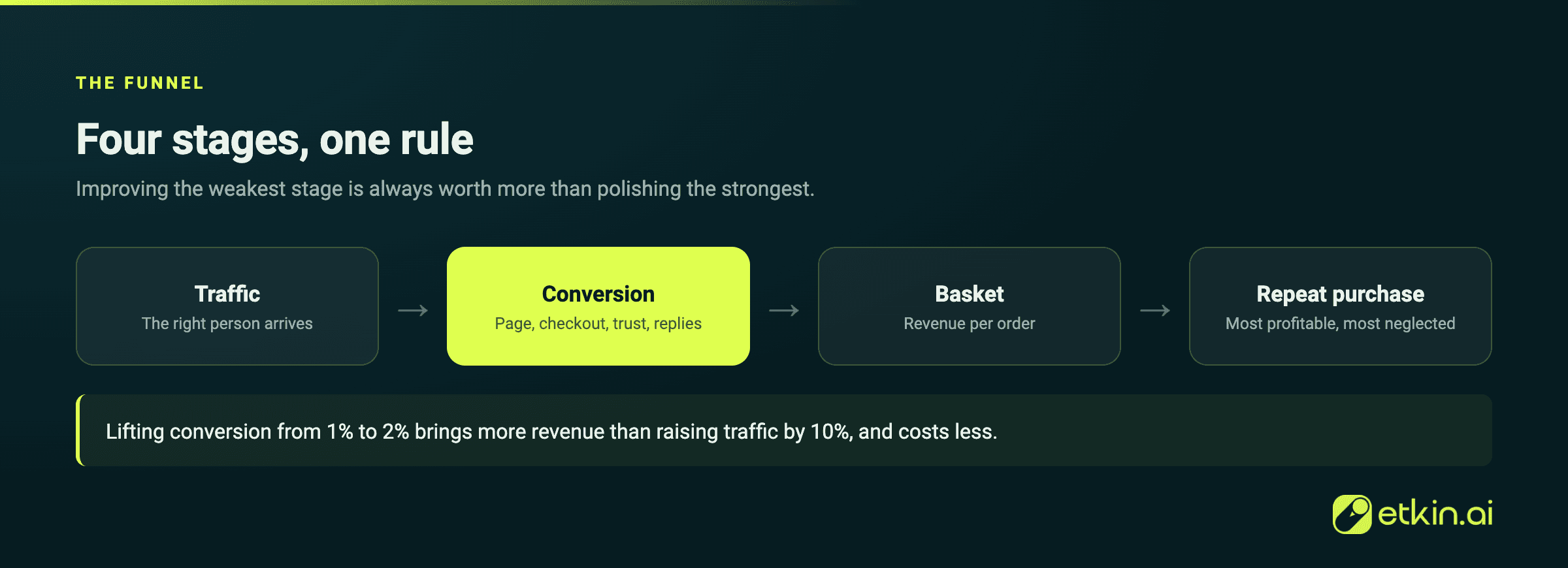
Growth does not come from one place. It comes from the whole funnel. Plan each stage separately.
- Traffic. Getting the right person to the site. Channel selection comes in the next step.
- Conversion. Turning arrivals into sales. Product page, checkout flow, trust and instant replies to messages decide this stage. An AI assistant meeting incoming questions keeps the most commonly lost revenue, the messages arriving at night and at weekends, inside the funnel.
- Basket. Growing revenue per order. Product recommendations, bundles, shipping thresholds, a nudge to the next model up.
- Repeat purchase. Selling to the same customer again. The most profitable and the most neglected stage.
The rule is simple: improving the weakest stage is always worth more than polishing the strongest. Lifting conversion from 1% to 2% brings far more revenue than raising traffic by 10%, and it costs less.
Step 4: Focus on the right channel instead of spreading thin
The biggest trap for a new brand is trying to exist on every channel at once. Resources scatter and no channel is fed well enough to master.
When choosing channels, look at whether those people are genuinely buyers and at conversion, not at volume. A channel that delivers crowds and sells nothing is more expensive than one delivering a few accurate customers. In practice: write down which channel your sales come from today, pick the two producing the most, put your budget behind them, and only try a new channel once those two are saturated and with a controlled budget. For the full set of options see how to drive traffic to your e-commerce site.
Step 5: Put retention and repeat purchase in order
What makes growth durable is not the new customer, it is the returning one. Acquiring a new customer is expensive; selling again to an existing one is almost free. Do not leave this stage to chance:
- A post-purchase flow: "how to use it", "are you happy", "time to reorder" messages.
- Permission-based campaigns: new product and campaign announcements over WhatsApp and email to customers who opted in. Repeat sales with no ad spend.
- Recovering lost revenue: bringing back abandoned carts and turning return requests into exchanges. A return is a double loss, revenue and shipping; an exchange offered before the return is final keeps a large share of that inside the funnel.
At high message volume this cannot be run by hand. At Isonem, 92% of nearly 82,000 requests were resolved without a human touch, giving the team back 347 hours a month. Those hours went into growth work that could never have been reached manually.
Step 6: Measure and test every week
A strategy starts ageing the day it is written. What keeps it alive is weekly measurement and testing. Every week look at the same four numbers (traffic, conversion, basket, repeat purchase) from the same place, mark where you stand against the goal, pick a single assumption to test that week ("shortening the checkout will raise conversion"), and measure the result. Make what works permanent and drop what does not. Small, continuous tests grow a business more safely than large, infrequent bets.
A 90-day skeleton
A simple template that fits the six steps into one quarter:
| Period | Focus | Output |
|---|---|---|
| Month 1 | Measurement and goal | Four numbers measured, weakest link identified, one goal set |
| Month 2 | Push on the weakest link | Three or four improvements tested in that stage |
| Month 3 | Systematise | What worked becomes permanent, retention flows built, measurement rhythm established |
When the quarter ends, start again. Whatever the new weakest link is becomes the focus of the next quarter.
Frequently asked questions
Is a growth strategy the same as a marketing plan? No. A marketing plan mostly covers traffic and channels. A growth strategy looks at the whole funnel and usually finds the biggest opportunity outside traffic, in conversion and retention.
Do I need one if I am a small brand? Especially when you are small. When resources are scarce, putting energy in the right place is existential. A strategy lets you say "a lot into the weakest place" instead of "a little of everything".
Which metric should I start with? Measure all four, then pick the weakest against typical ranges. If traffic is good and conversion is low, focus on conversion; if both are fine and repeat purchase is low, focus on retention.
How often should it be updated? Look at the numbers weekly and review the main focus quarterly. When the weakest link changes, the focus changes with it. A strategy is not a fixed document, it is a turning wheel.
Is an ad budget essential? No. Conversion, basket and repeat purchase all work without extra advertising and usually deliver the most profitable growth. Advertising becomes most efficient once those three are solid.
Read next
- How to Increase E-Commerce Sales: 25 Proven Methods
- How to Drive Traffic to Your E-Commerce Site: 18 Channels
- The 30-Question E-Commerce Growth Audit
The most profitable stage of your strategy, and the hardest to grow by hand, is customer communication. If you want to solve that stage with a system rather than more people, let us show you in 15 minutes what Etkin AI does for your brand. Get started