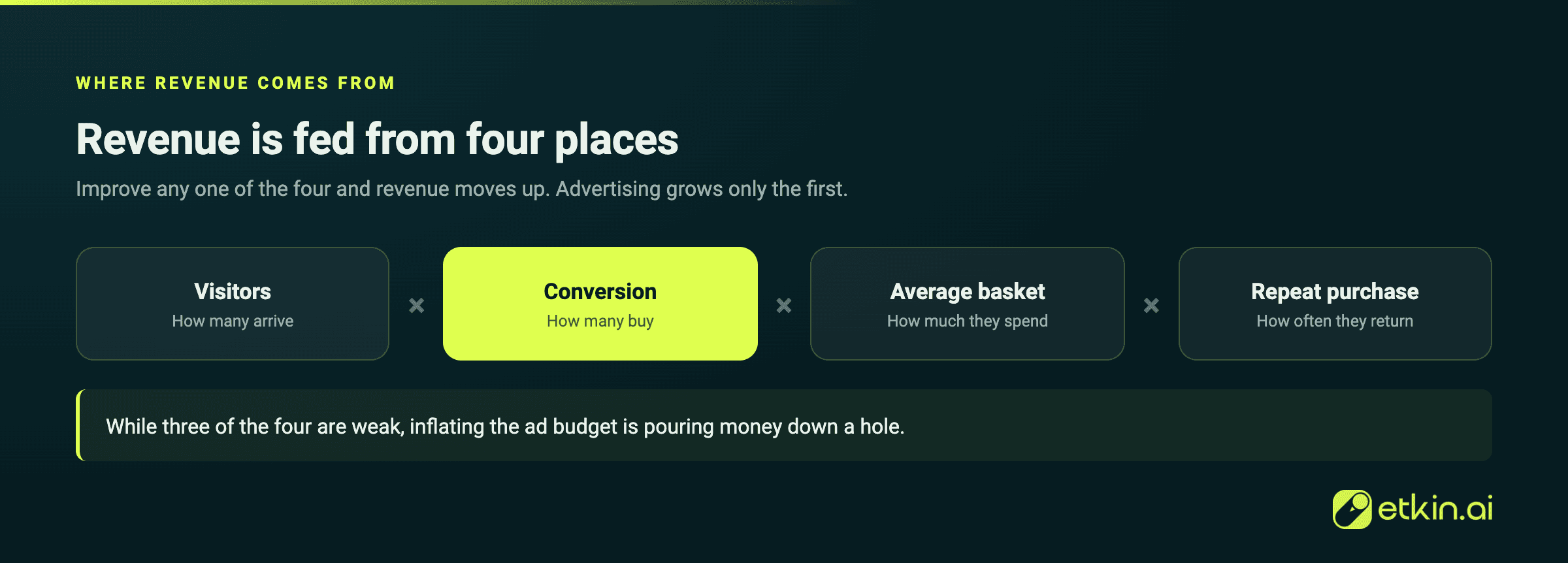
For most brands, the answer to "how do I increase sales" comes down to one word: advertising. But revenue does not flow from a single tap. It is fed from four places: how many people arrive, how many of them order, how much each one spends, and how often the same customer comes back. Improve any one of those four and revenue moves up directly. Advertising only grows the first. While the other three are weak, inflating the ad budget is pouring money down a hole.
Below are 25 methods that grow those four areas. All of them are things you can start on today. First, a look at how revenue is actually built.
Before you start: find what is stuck
Pause for a minute before diving into the list. The most common mistake is polishing the area you are already good at while never touching the one that is actually broken. So look at four numbers first.
| What is measured | How to check | Sign of weakness |
|---|---|---|
| Traffic | Monthly visits and source split | Too little traffic, or dependence on one channel |
| Conversion | Orders divided by visits | Usually below 1%, traffic arrives but nothing sells |
| Average basket | Revenue divided by orders | Everyone buys a single item and leaves |
| Repeat purchase | Share of returning customers | Customers buy once and never reappear |
A simple rule: if you have traffic but no sales, the problem is most likely conversion or trust, and adding advertising just burns money faster. If traffic is low too, then acquisition is where to look.
1) Bring in more of the right visitors
1. Publish content for search. Write down the answers to the questions your customer asks before buying ("which one suits me", "how do I use it"). This becomes an asset that keeps bringing traffic long after an ad budget runs out.
2. Be fast on marketplaces. Marketplace rankings depend not only on price but on your response speed and store rating. Answering late lowers sales and pushes you down the list. Stores that reply within seconds outrank competitors on the same product.
3. Use the list you already have. A permission-based email and WhatsApp list is a zero-cost traffic source. New collections, restocks, campaigns: announce them all there. Revenue comes out of it without any ad spend.
4. Turn the customer's voice into content. Real reviews, usage videos and before-and-after posts build social reach and make buying easier at the same time.
5. Focus on two channels rather than spreading across all of them. Being genuinely good on the two channels that bring your best customers beats being average everywhere. A channel that delivers crowds but never sells is more expensive than one that delivers a few accurate buyers.
2) Turn arrivals into sales
For most brands the biggest opportunity sits here. Lifting conversion from 1% to 2% produces the same revenue as doubling traffic, and at a fraction of the cost.
6. Answer messages instantly. In e-commerce, a purchase often starts with a question: "will this fit me", "when will it arrive", "is it in stock". If that question goes unanswered, or gets a reply two hours later, the customer has already bought elsewhere. Most of the lost sales happen at night and at weekends, when the team is not there.
That is exactly what happened at Defne Home. Once every message on Instagram and WhatsApp was answered instantly, including the ones arriving at midnight, 5% of incoming DMs turned directly into orders and the brand gained 24 million lira in additional monthly revenue. The details are in the Defne Home story.
7. Let the product page do the talking. Clear photos, sizing and usage information, delivery time and return terms should all be visible. If the customer finds the answer on the page, they buy without sending a message.
8. Shorten the checkout. Every extra form field and every forced registration loses another customer. Allow guest checkout, simplify the address form, offer more payment options.
9. Build trust. A return guarantee, secure payment badges, real reviews and visible contact details break the hesitation of someone buying from you for the first time.
10. Make the site faster. A slow page, especially on mobile, is a sale walking away. Compress images, remove unnecessary plugins.
11. Bring back abandoned carts. Someone who added a product and left is your closest customer. A WhatsApp or email reminder calls them back. Build something that sends that reminder at the right moment on its own and a share of those carts turns into orders with no manual work.
12. Handle objections before the purchase. Put the answers to "what if it does not fit", "how much is shipping", "can I exchange it" on the product page and in your FAQ, so hesitation resolves before it costs a sale.
3) Grow the basket
Selling one more item to the same customer on the same visit costs you no extra acquisition. The most profitable growth hides here.
13. Recommend what goes with it. Show complementary products. A good recommendation grows the basket and helps the customer at the same time.
14. Show the next model up. While a customer is looking at a product, explain clearly what the tier above would give them.
15. Set the free shipping threshold intelligently. A threshold slightly above your average basket pushes customers to add one more item.
16. Build bundles. Turn frequently combined products into discounted sets. The basket grows and stock balances out.
17. Encourage quantity. Buy-two-get-one or tiered discounts protect unit profit while lifting the total basket.
18. Personalise recommendations. Suggestions based on what a customer viewed and previously bought perform far better than a generic bestsellers list.
4) Sell to the same customer again
Finding a new customer costs several times more than selling again to an existing one. Raising your repeat purchase rate is the most reliable way to grow without touching the ad budget.
19. Run permission-based WhatsApp campaigns. Send new product, restock and campaign messages to customers who opted in. A message with the right timing and a personal tone brings repeat sales without a penny of ad spend.
20. Do not leave the post-purchase period empty. "How to use it", "are you happy with it" and "time to reorder" messages raise both satisfaction and repeat purchase.
21. Build a simple loyalty structure. A small system that rewards repeat purchases keeps a customer from drifting to a competitor.
22. Catch the moment it runs out. For consumables like cosmetics, food and personal care, a reminder timed near the estimated finish date is the highest-converting repeat purchase trigger there is.
5) Recover the money that leaks away
This is the area most brands never look at.
23. Turn returns into sales or exchanges. A return is a double loss: the revenue goes and shipping cost comes on top. But not every return request is final. A well-timed exchange or alternative offered before the customer decides keeps a serious share of returns as sales. At a mobile accessories brand, offering a free exchange or a special discount the moment a return request arrived, even at midnight, turned 43% of return requests into a sale or an exchange, with 99% of the process completed without human involvement.
24. Drop no messages on a busy day. During a campaign, messages explode, the team falls behind, and the customer waits at exactly the moment sales peak. At Mervellion, more than 800 DMs arrive daily and 89% of them are answered without a human touch, so nothing goes unanswered even on the busiest day. At Isonem, 92% of nearly 82,000 requests were resolved automatically, giving the team back around 347 hours a month.
25. Send the right question to the right place. Misrouting costs both time and satisfaction. A system that understands the request and carries it to the right resolution lets even small teams handle heavy message volume with quality. At Rainwater, correct routing reached 95.7% and a small team gained more than 80 hours a month.
Most of these 25 methods meet in the same place
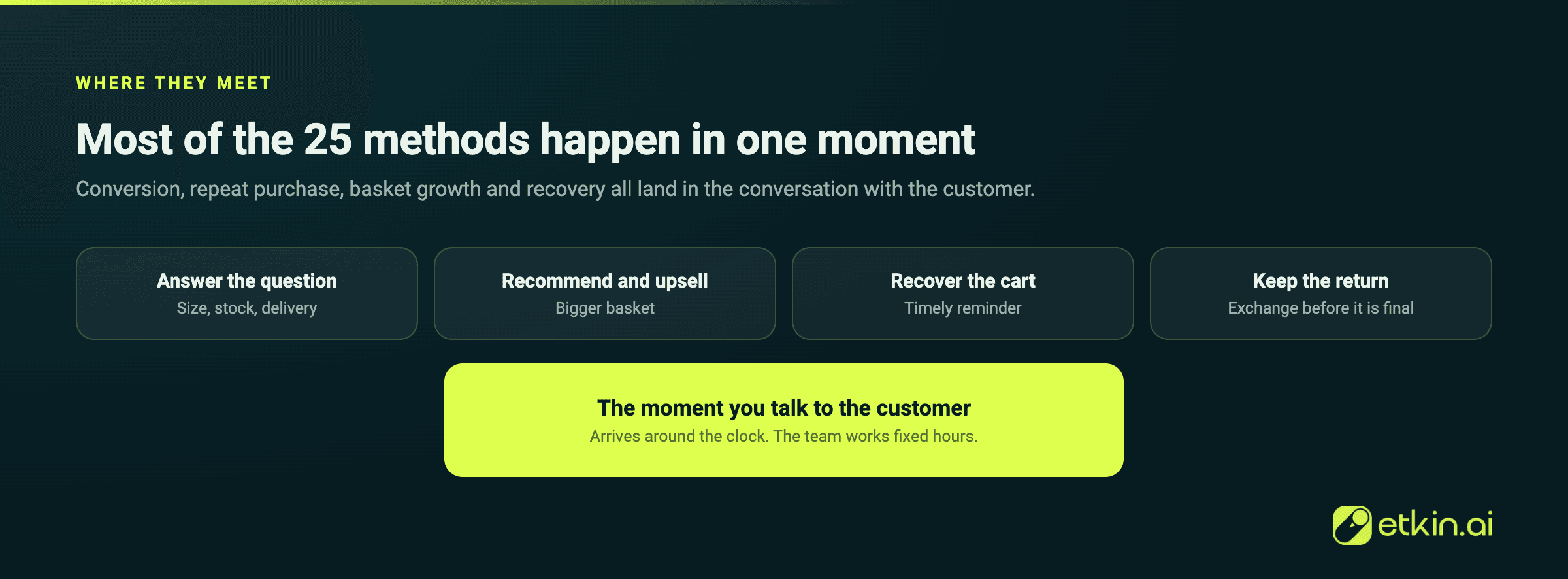
Look at the list again. Conversion (6, 11), repeat purchase (19, 20), basket growth (13, 18), recovering lost revenue (23, 24, 25): all of them happen in the moment you are talking to the customer. The problem is that this moment arrives around the clock, while the team works fixed hours and is limited in number.
That is exactly the problem Etkin AI was built to solve. On WhatsApp, Instagram, website chat and email, an AI assistant speaks in the brand's own voice using its real stock, pricing and order data. It answers the question, recommends products, grows the basket, closes the payment, tries to keep a return as a sale, and drives repeat purchases with permission-based campaigns. Not a template bot, but an assistant connected to the brand's own systems and working from real data.
In short: for most brands, turning the messages you already receive into sales produces a faster revenue increase than buying new traffic.
Frequently asked questions
Where do the fastest results come from? Usually not from new advertising, but from making better use of the traffic you already have. Answering messages instantly, recovering abandoned carts and shortening the checkout all grow revenue without a penny of ad spend.
Can sales grow with no ad budget? They can. Repeat purchase, basket growth and recovering lost revenue need no advertising, and they usually deliver the most profitable growth.
How do I know if my conversion is low? Divide orders by visits. In e-commerce the figure usually sits between 1% and 3%. If you are below that and you do have traffic, the problem is most likely conversion or trust.
We cannot keep up with messages and sales are slipping. What should we do? Build something that meets every message instantly, around the clock. Most lost sales happen at night and at weekends, when nobody is there. An AI assistant can meet those messages without delay and carry them through to a sale.
Our return rate is high. How does that affect sales? A return is a double loss: revenue plus shipping. An exchange or alternative offered before the return is final keeps a significant part of that loss as sales.
Read next
- How to Build an E-Commerce Growth Strategy
- How to Drive Traffic to Your E-Commerce Site: 18 Organic and Paid Channels
- Why Are Online Sales Dropping? A Diagnostic Guide
If you want to turn more of your messages into sales, overnight ones included, let us show you in 15 minutes what Etkin AI can do for your brand, using your own channels and your own data. Get started