When growth stalls, the problem is rarely a lack of ideas. It is a lack of diagnosis. Everyone senses that something is stuck, but nobody can point to the number that proves where. The 30 questions below exist for exactly that. You answer yes or no across six areas, and at the end you hold a table showing where your brand is quietly bleeding.
It takes about half an hour. One rule: if you are not sure of an answer, count it as a no. Something you cannot answer with confidence is not being measured, and what is not measured is not being managed. Each area has 5 questions, and every yes is one point.
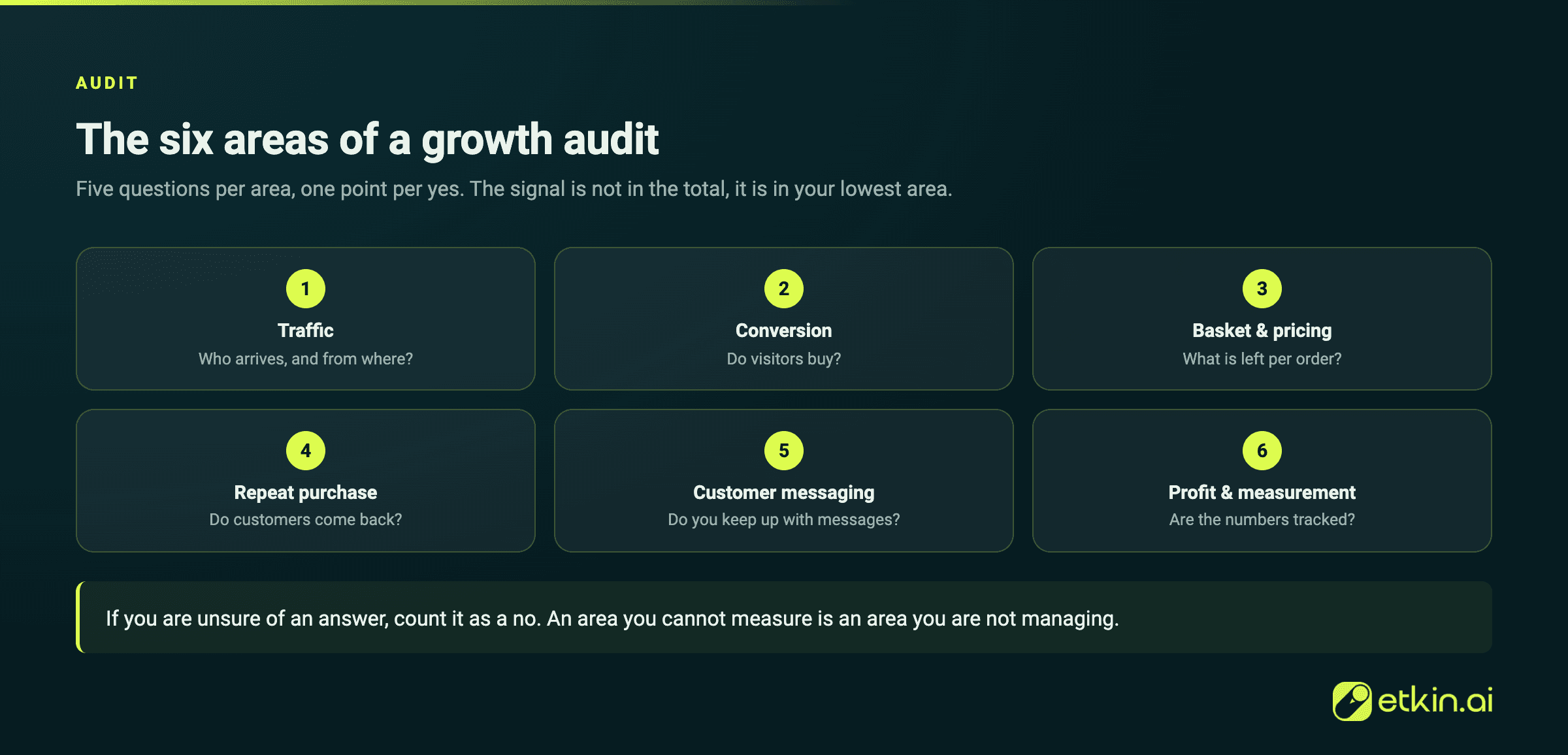
Area 1: Traffic (5 questions)
- Can you see your monthly visitor count and its source breakdown (search, social, ads, direct) in one place?
- Is less than half of your revenue coming from a single channel?
- Do you have at least one channel that brings customers regularly without paid ads (search, content, email, community)?
- Do you know how many orders each channel produces, not just how many visits?
- Have you tested a new channel with a controlled budget in the last three months?
A low score here usually means dependence on one channel. The day that channel's algorithm or cost changes, your revenue changes with it.
Area 2: Conversion (5 questions)
- Do you know your conversion rate (orders divided by visits)?
- Is it above 1%?
- Is your mobile conversion at least half of your desktop conversion?
- Can you see how many people abandon the checkout step?
- Do your product pages answer questions about sizing, delivery time and returns on the page itself?
If your score is low here, buying more traffic is the most expensive option available to you. Every new visitor leaks out of the same hole.
Area 3: Basket and pricing (5 questions)
- Do you know your average order value?
- Is your free shipping threshold slightly above the average basket, so it nudges customers to add one more item?
- Is a related-product recommendation working on the product or cart page?
- Do you offer bundles, sets or multi-buy options?
- Do you calculate the margin impact of a campaign discount before running it?
Weakness here is a quiet loss, because revenue holds steady while profit erodes. Revenue that grows on the back of discounts is often profit that shrinks.
Area 4: Repeat purchase (5 questions)
- Do you know what percentage of your customers buy a second time?
- Is that number above 20%?
- Do you have an automated post-purchase message flow (delivery, usage, satisfaction)?
- Do you have a list you can reach without paying for ads (WhatsApp, email) from customers who opted in?
- Do you send reminders for products that run out or need renewal?
Repeat purchase is the most profitable and the most neglected area in e-commerce. A new customer costs advertising money every time. An existing one does not.
Area 5: Customer messaging (5 questions)
- Do you know your average response time to an incoming message?
- Are messages that arrive outside business hours, in the evening and at weekends, answered?
- Can you see WhatsApp, Instagram, website chat and marketplace messages in one place?
- Do you know what share of incoming questions are repeat questions like "where is my order"?
- When a return request arrives, is an exchange or an alternative product offered before the return is finalised?
This is the area that surprises brands most. While everyone discusses traffic and conversion, this is usually where the sale actually disappears.
Area 6: Profit and measurement (5 questions)
- Do you know your contribution margin per product, including cost of goods, shipping, commission and returns?
- Do you calculate what it costs you to acquire one customer?
- Do you track your return rate and the real cost of a return?
- Can you see the net profit of your marketplace sales after commission?
- Do you have a routine of reviewing these numbers weekly, from the same place?
A low score here corrupts the other five areas. You cannot improve what you do not measure, and you cannot prove an improvement either.
How to read your score
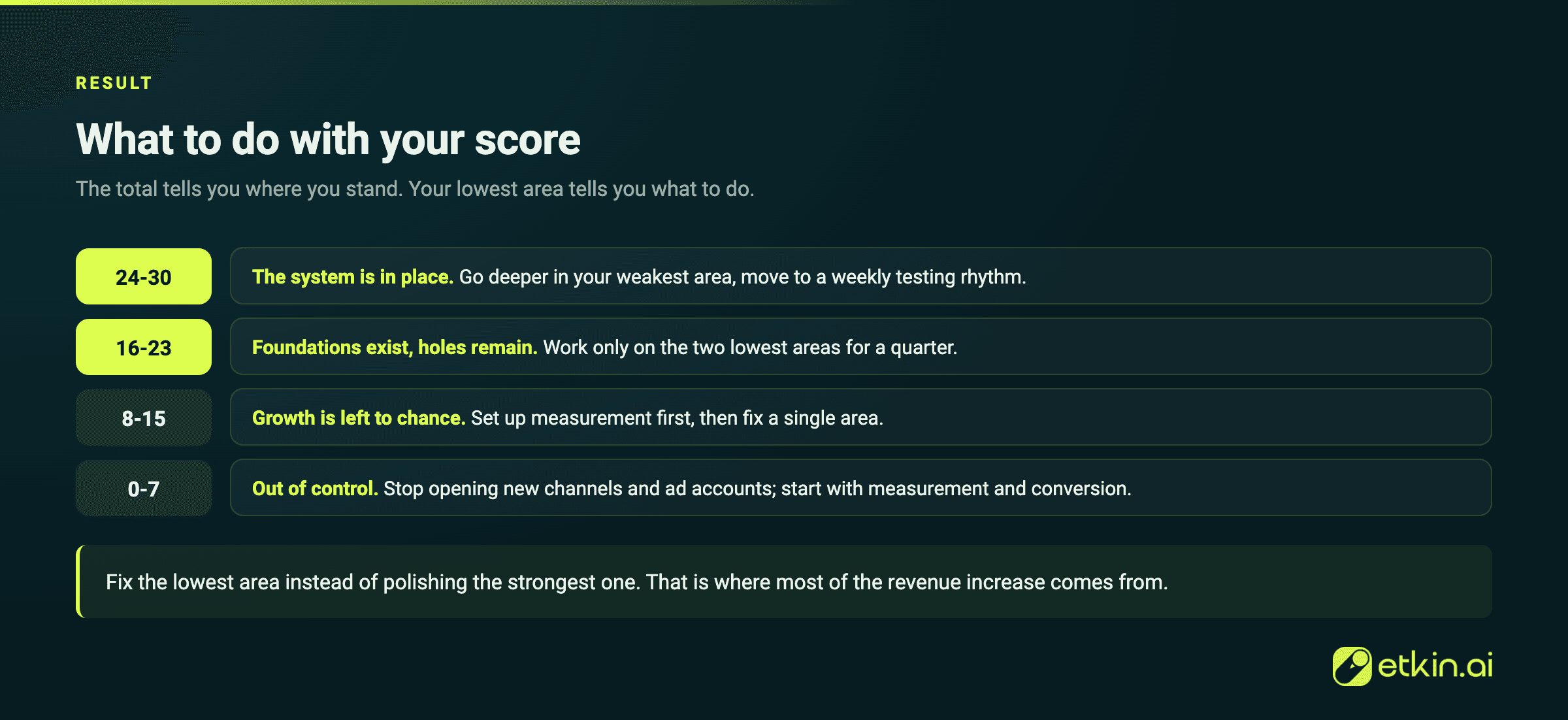
Take your total, then look area by area. The useful information is not in the total. It is in your lowest area.
| Total score | Where you stand | First move |
|---|---|---|
| 24-30 | The system is in place | Go deeper in your weakest area, move to a weekly testing rhythm |
| 16-23 | Foundations exist, holes remain | Pick the two lowest areas and work only on those for a quarter |
| 8-15 | Growth is left to chance | Set up measurement first, then fix a single area |
| 0-7 | Out of control | Stop opening new channels and ad accounts; start with measurement and conversion |
The order matters. Leaving your weakest area alone to polish your strongest one is the most common and most expensive mistake in the list. In a brand converting at 1%, lifting traffic by 30% does less work than lifting conversion to 1.5%, and it costs several times more.
The area that fails most often: customer messaging
When we run these 30 questions in the field, area five is the one that hits bottom most often. The reason makes sense. Traffic and conversion have dashboards, reports and agencies behind them. Nobody measures how many incoming messages went unanswered, so the loss stays invisible.
The size of that invisible loss shows up when it finally gets measured. At Isonem, 92% of nearly 82,000 customer requests were resolved without a human touching them, giving the team back around 347 hours a month. Those hours were being spent before too, just on repeat questions. At Defne Home, once every message was answered instantly, including the ones arriving overnight, 5% of DMs turned directly into orders.
Etkin AI puts this area in order: it connects to the brand's real stock, pricing and order data, answers messages across WhatsApp, Instagram, website chat and marketplaces around the clock, and tries to turn a return request into an exchange. In other words, it closes the lowest-scoring area of the audit without growing the team.
Make the audit a routine
An audit run once gives you a photograph. An audit run regularly gives you direction. Answer the same 30 questions every quarter and place the scores side by side. You will see which area is climbing and which one is standing still. That table settles the argument about where your energy should go next quarter.
Frequently asked questions
Who should run this audit? Whoever has access to the numbers, usually the founder or the e-commerce manager. Having several people fill it in separately also works well; the questions where answers differ are usually the ones with no measurement behind them.
What do I answer when I am unsure? No. Uncertainty means that area is not being measured, and a measurement gap holds growth back just as much as poor performance does.
My score is low. Where do I start? With your lowest-scoring area. Do not try to raise the total. Strengthen the weakest link, because that is where most of the revenue increase comes from.
How often should I repeat it? Once a quarter is enough. More often produces no meaningful difference, once a year means you find out too late.
Could I have an agency run an analysis instead? You could, but most agency analyses look at traffic and advertising. Areas four, five and six on this list usually fall outside their scope, and that is where much of the profit is hiding.
Read next
- How to Grow a D2C Brand: Channels, Repeat Purchase and Profitability
- Why Do Operations Break When Sales Grow?
If customer messaging scored lowest in your audit, let us show you in 15 minutes how much revenue that area is costing your brand, using your own channels and your own data. Get started