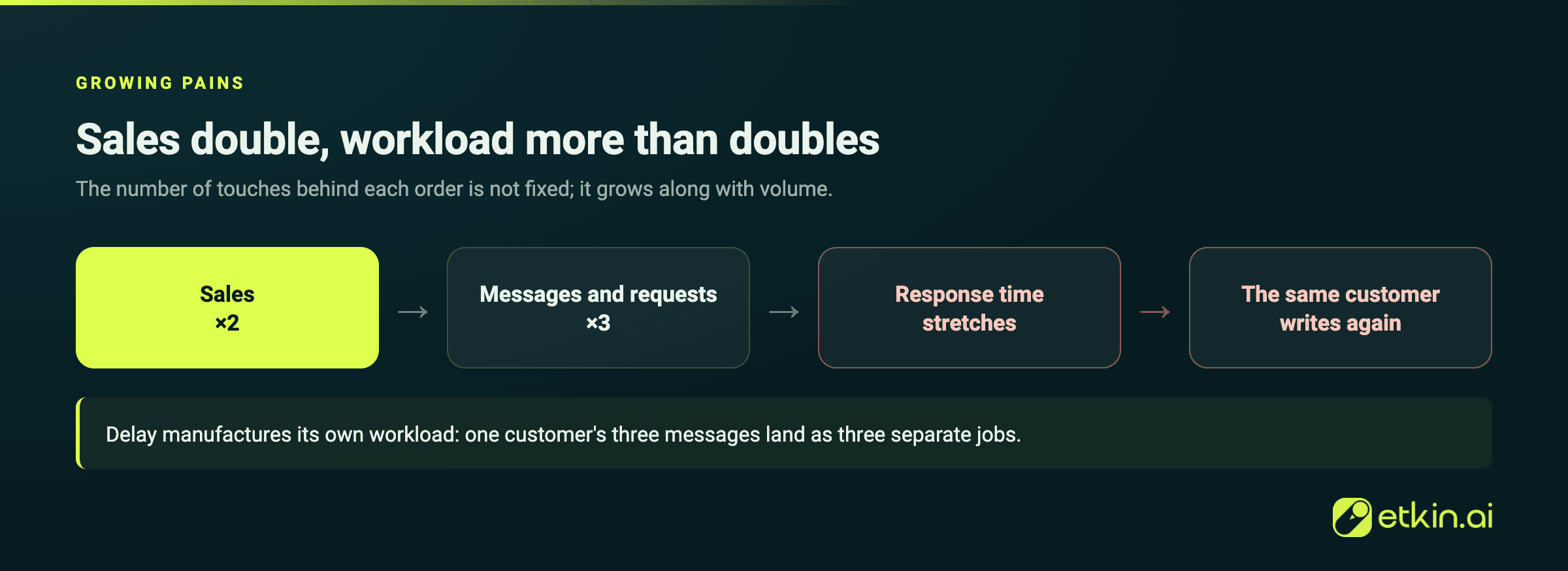
When your sales double, your workload does not double. It grows by more. The reason is simple: the number of touches behind each order is not fixed. More orders bring more questions, heavier shipping volume brings delays, delays multiply the "where is my order" messages, the team falls behind, response times stretch, and the same customer writes a second time. So the sales line rises in a straight line while the workload line curves upward.
The first department to notice this is rarely finance. It is customer service. The week you break a revenue record is often the week your team is most miserable. Below is why this jam is close to inevitable, and where it actually gets solved.
Why workload grows faster than sales
The touch multiplier. If 100 orders bring an average of one question per customer, 400 orders do not bring four. They bring six or seven. Volume raises the share of first-time customers, the number of product variants and the margin for error, and a first-time customer always asks more questions than a returning one.
The delay spiral. As response time stretches, the same customer writes again, and writes on another channel too. One customer's three messages land in front of your team as three separate jobs. Delay manufactures its own workload.
Channel count. As a brand grows, WhatsApp gets joined by Instagram, then website chat, then marketplace messages. Every new channel adds not just messages but a separate screen, a separate shift and a separate tracking burden.
Campaign compression. An operation built for ordinary days meets three or four times the usual volume during peak season. The jam surfaces on those days, but it was not created on those days.
The four places it breaks
| Symptom | Actual cause | Visible result |
|---|---|---|
| Messages pile up unanswered | Channels and touches multiplied, the team did not | Lost sales outside business hours, falling conversion |
| A flood of "where is my order" | Order status does not reach the customer on its own | Most of the team's time goes to repeat questions |
| Returns and exchanges back up | The process runs by hand, no alternative offered before the return is final | Double shipping cost, a sale lost |
| Stock and pricing drift | Syncing between the site and marketplaces is manual | Selling what you do not have, cancellations, falling ratings |
These four feed each other. Stock drifts, so an order gets cancelled. The cancellation produces messages. Messages pile up, so replies slow down. Slow replies produce complaints and returns. This is the state brands describe as "we are just putting out fires".
Why hiring does not fix it
The most common response is to add people. That is a slow and expensive fix, for three reasons:
- Cost grows in a straight line, volume does not. Message volume triples during a campaign. You cannot triple the team, and you would have to carry it for the rest of the year.
- Training takes time. A new agent needs weeks to learn the products, the return rules and the shipping process. By the time they are up to speed, the peak season is over.
- The shift problem remains. Messages do not arrive during your working hours. Hiring people to answer a question that lands at eleven at night is the most expensive solution there is.
A new hire also grows the repeat work along with everything else. Having a second person answer "where is my order" does not solve the question itself.
What goes to a system, what stays with people
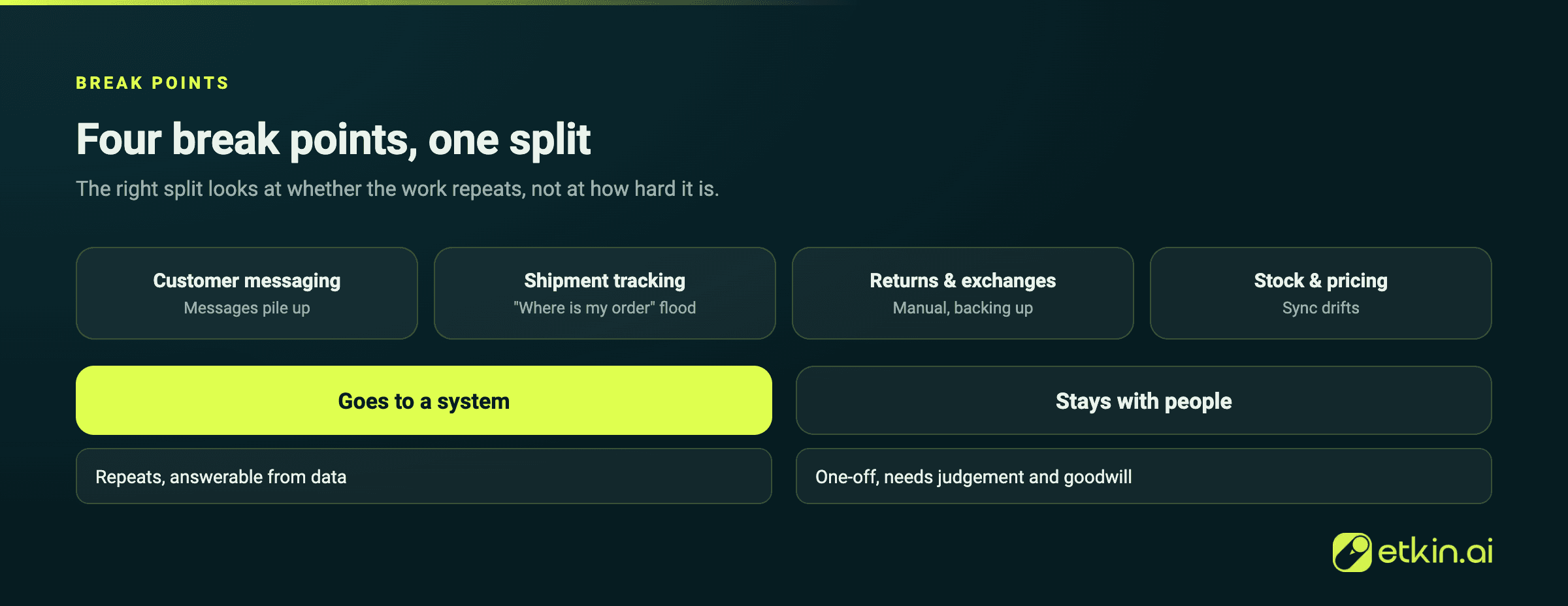
The right split does not look at how difficult the work is. It looks at whether the work repeats.
| Goes to a system (repeats, answerable from data) | Stays with people (one-off, needs judgement) |
|---|---|
| Order status, shipment tracking, delivery dates | Calming an angry customer |
| Stock, sizing, pricing, campaign terms | Exception decisions, goodwill and compensation |
| Return conditions, starting a return, offering an exchange | Corporate and wholesale requests |
| Cart reminders, product recommendations | Interpreting feedback that should reach product development |
In brands that make this split, the team's workload does not shrink. It changes. The time freed from repeat questions goes into selling and retention. At Isonem, 92% of nearly 82,000 requests were resolved without a human touching them, giving the team back around 347 hours a month. At Mervellion, 89% of more than 800 daily DMs were handled the same way. At Rainwater, correct routing reached 95.7% and more than 80 hours a month were saved.
Building exactly that split is what Etkin AI does: it connects to the brand's stock, order and pricing data, answers repeat questions across every channel around the clock, tries to turn a return request into an exchange, and hands the conversations that need judgement to the team. Volume can grow while the team stays the same size.
Campaign days are the real test
The strength of your operation is not revealed on an ordinary Tuesday. Peak sale days and year-end campaigns are the true measure of the load your system can carry. If response times stretch, returns pile up and stock drifts on those days, the problem is not the campaign. It is the system underneath it.
A simple readiness test: what breaks if three times today's volume arrives? If you do not know the answer, the 30-question growth audit will show you in half an hour which area is already at its limit.
Frequently asked questions
My sales went up but my profit did not. Could this be why? Very likely. If support, return and cancellation costs per order grow along with volume, revenue rises while contribution margin erodes. It stays invisible until you measure these items per order.
I am a small brand. Is this my problem? The jam is not created by volume, it is created by a jump in volume. A small brand's first big campaign produces the same result. Building the system before you grow is easier than building it while growing.
Which break point should I fix first? The one that consumes most of your team's time. In most brands that is repeat order and shipping questions. The time freed there lets you fix the other three.
Doesn't automation hurt the customer experience? What hurts it is badly built automation, not automation itself. A system answering from real stock and order data delivers a better experience than a human reply four hours later. Conversations that need judgement still go to people.
Doesn't the problem solve itself once the busy period passes? The busy period passes. The customers you lost do not. Unanswered messages and late deliveries come back as lower repeat purchase in the months that follow.
Read next
- The 30-Question E-Commerce Growth Audit
- How to Grow a D2C Brand: Channels, Repeat Purchase and Profitability
If you want to see today what will break when your volume triples, let us show you in 15 minutes, using your own channels and your own data. Get started