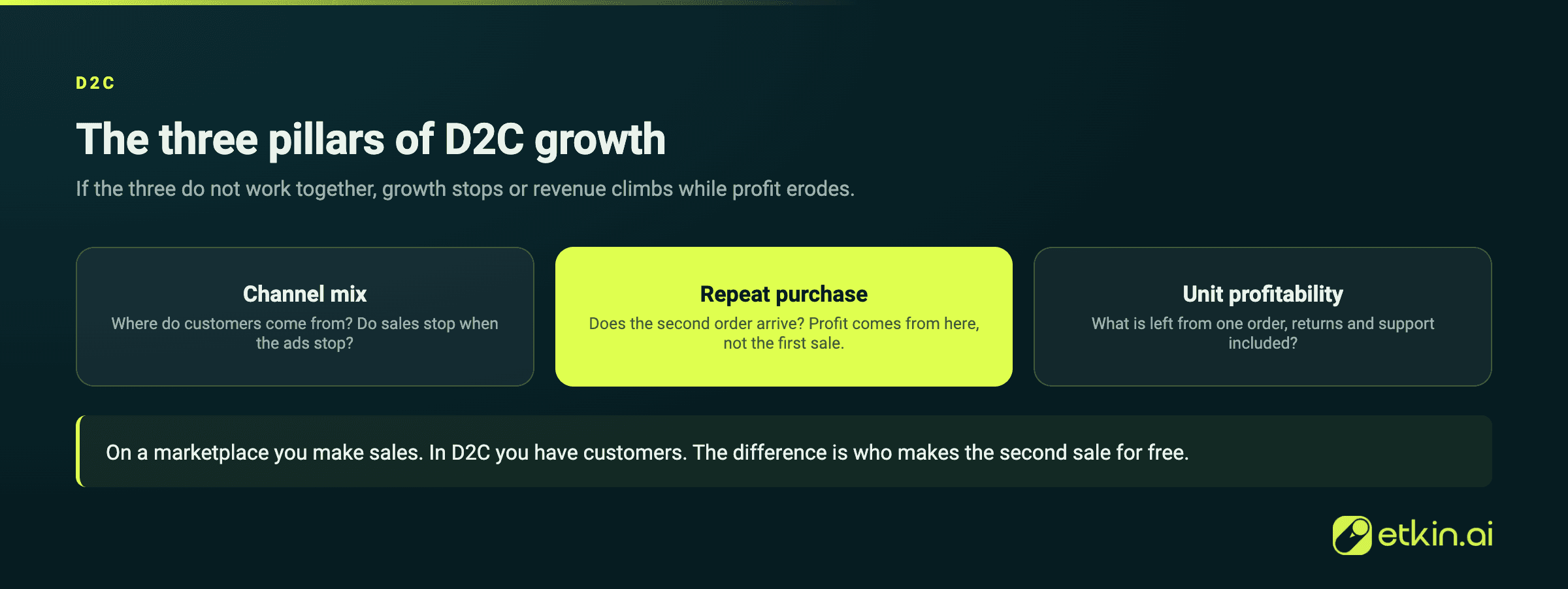
Growing a D2C brand comes down to three things: where you bring customers from, whether you carry them to a second purchase, and what is actually left over from an order. When these three are not working together, growth either stops or revenue climbs while profit erodes. A brand selling on a marketplace has volume. A D2C brand has customers. The difference is who gets to make the second sale for free.
D2C means selling without a middle layer. No marketplace, no distributor, no retail chain between you and the buyer. That has a price: you have to find, convince and keep the customer yourself. In return you get the one thing a marketplace never hands over, which is knowing who your customer is, what they bought and how to reach them.
Pillar 1: Channel mix
The most expensive mistake new D2C brands make is putting the entire budget into one paid channel. If sales stop the day you pause the ads, it is not your brand that is growing. It is your ad account.
A healthy mix looks like this:
| Channel type | What it gives | Its risk |
|---|---|---|
| Paid advertising | Fast, measurable volume | Sales stop when spending stops, and costs rise every year |
| Search and content | Traffic that gets cheaper over time | Slow to build, demands patience |
| Social and community | Brand awareness, direct message traffic | Hard to measure, labour intensive |
| Marketplace | First contact with new customers, volume | The customer is not yours, margins are thin |
| Your own list | Repeat sales with no ad spend | Has to be built first |
Rejecting marketplaces outright is also a mistake. They hold buyers who have never heard of you, and the first contact is cheap. The right way to use them is this: find customers on the marketplace, then build a path that carries those customers into your own channel. A card in the box, usage content, a warranty registration or a refill reminder all do that job.
Pillar 2: Repeat purchase
For D2C brands, profit does not come from the first sale. It comes from the second and the third. On the first order you carry advertising cost, shipping, return risk and payment fees all at once. On the second order, most of that is gone.
Run the numbers. Say acquiring a customer costs you ₺300, and the contribution left from an average order is ₺250. On the first sale you are ₺50 down. If that same customer buys twice more within six months, you end up ₺450 ahead. So the real job of this brand is not selling a product. It is producing the second order.
Brands that refuse to leave repeat purchase to chance build these four:
- Post-delivery contact. A "how to use it" message after the product arrives lowers returns and raises satisfaction.
- Refill timing. However long the product lasts, that is when the reminder goes out. In skincare, supplements and cosmetics this is the strongest repeat-purchase lever available.
- A permission-based list. Customers who opted in on WhatsApp and email are the only audience you can reach without paying. The size of that list is a D2C brand's most valuable asset.
- Winning back the lapsed. One message to a customer who has not bought in 90 days brings in sales far more cheaply than the same budget spent hunting new ones.
A natural care brand that put this system in place grew its revenue fourfold in ten months, from ₺1.5 million to ₺6 million. Around a third of that increase came directly from conversations with customers.
Pillar 3: Unit profitability
There is no shortage of D2C brands whose revenue grows while profit shrinks. The cause is usually one number nobody ever calculates: what is left from a single order.
Count these line by line: cost of goods, shipping, payment fees, packaging, returns and return shipping, customer acquisition cost, support cost. If what remains is positive, growth is safe. If it is negative, every new order deepens the loss and raising the ad budget makes it worse.
Two items get overlooked in particular. First, returns: on a returned product you lose the sale, the outbound shipping, the inbound shipping and the labour of repacking, so the damage is more than lost revenue. Second, support cost: as the number of messages per order climbs, an expense you cannot see grows with it. You can see where you stand on both in half an hour with the 30-question growth audit.
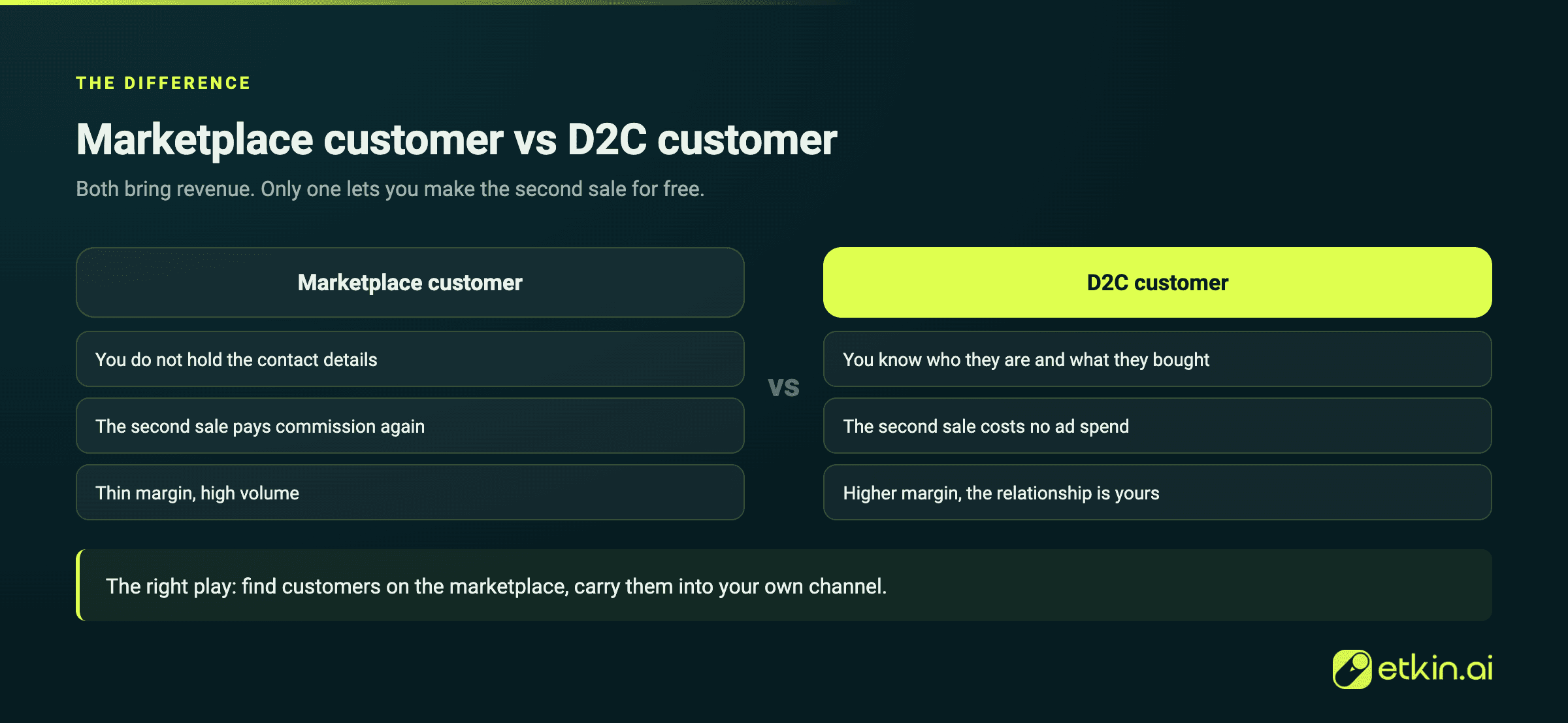
The real D2C advantage: talking to the customer directly
On a marketplace you make sales. In D2C you build a relationship. If that relationship stays a slogan it is worth nothing. What makes it worth money is what you actually do in the channel where you speak to the customer one to one.
The truth is that this channel is running half-empty at most brands. A question comes in on Instagram at nine in the evening and goes unanswered. A sizing question on WhatsApp slides to the next day, and that customer buys somewhere else. The scale of the loss shows up once it is measured. At Defne Home, once every message was answered instantly, overnight ones included, 5% of DMs turned directly into orders and the brand reached ₺24 million in additional monthly revenue. At Mervellion, 89% of more than 800 daily DMs were resolved without a human touching them.
Etkin AI does this with the brand's own data: it connects to stock, pricing and order information, answers questions on WhatsApp, Instagram and website chat around the clock, brings back abandoned carts and tries to turn a return request into an exchange. It takes the biggest advantage a D2C brand has and makes it usable without growing the team.
The three most common mistakes
Trying to be everywhere at once. Being mediocre on five channels produces fewer sales than being excellent on two. Write down where your sales come from today, then put the budget behind the first two.
Discounting without checking the margin. Campaign revenue looks great and the month-end profit sheet looks broken. A discount decision is made before the campaign, together with the contribution margin.
Not building the customer list. Advertising costs rise every year. If you do not hold a permission-based list, making the same sale three years from now will cost considerably more than it does today.
Frequently asked questions
Are D2C and e-commerce the same thing? No. E-commerce is the general term for selling online. D2C means selling directly to the end customer with no intermediary. A brand selling on a marketplace is doing e-commerce, but not D2C, because the customer relationship and the data stay with the marketplace.
Should I leave marketplaces? No. Marketplaces are a cheap way to meet new customers. The right move is to build a path that carries those customers into your own channel, and to concentrate your high-margin sales on your own site.
What is a healthy repeat purchase rate for a D2C brand? It varies by category, but below 20% is a warning sign for most brands. If you sell a consumable, expectations are higher. If you sell something durable, it can reasonably be lower.
How do I grow when my ad budget is small? The fastest results come from people who have already reached you: those who sent a message, left a cart behind or bought once and never returned. They cost no advertising money and convert better than new traffic.
Should I invest in my own site or in social media? They are two ends of the same job. Social creates the interest, the site closes the sale. But interest turns into sales through the answers given to the messages in between, and if that middle is empty both investments are wasted.
Read next
If you are wondering how many sales slip away in the channel where your brand talks to customers directly, let us show you in 15 minutes, using your own channels and your own data. Get started