Building a sales funnel means splitting the path from the moment a customer first sees you to their second order into five stages, and measuring one number at each. Its purpose is not to make sales. It is to make visible where sales disappear. Before the funnel exists, "sales are not going well" is a feeling. After it exists, it becomes "we lose 80 out of every 100 people between evaluation and purchase". You can work with the second one.
Most brands already have a funnel. It is simply not written down. Visitors arrive, look, ask, and buy or leave. Because nothing is written, nobody can see which stage is bleeding, and the budget goes to the most visible place every time, which is traffic.
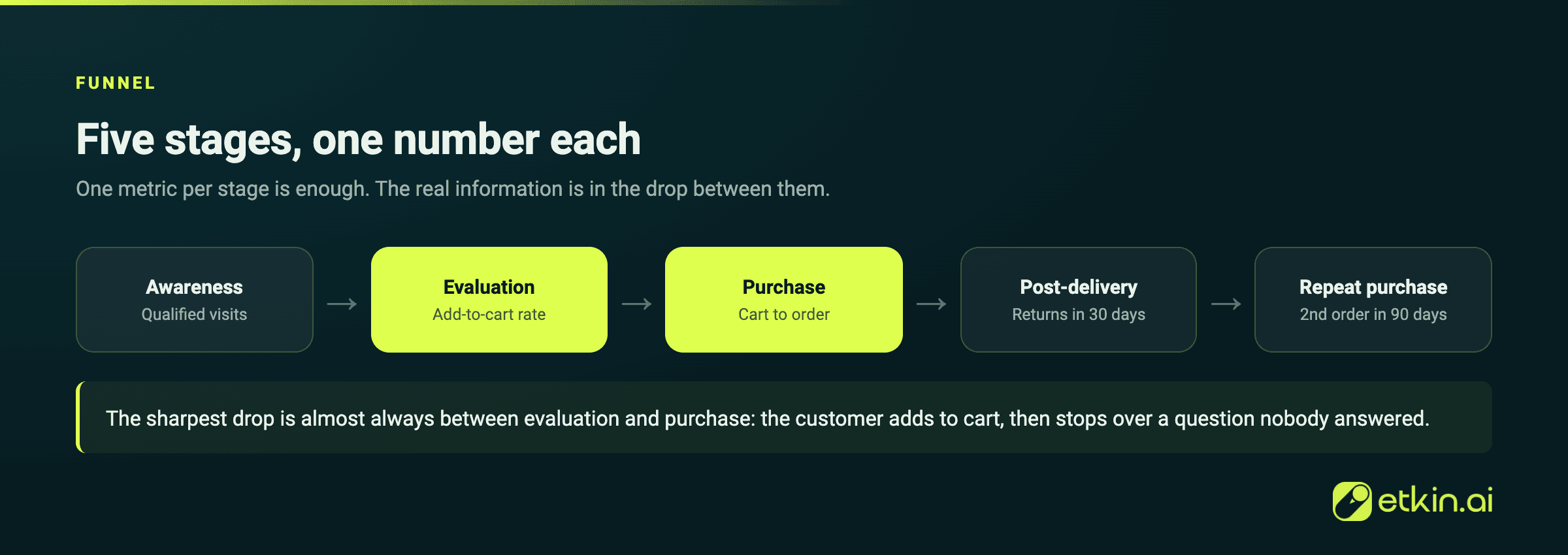
Five stages, one number each
Do not track more than one metric per stage. One number is enough; the team watches it and talks when it moves.
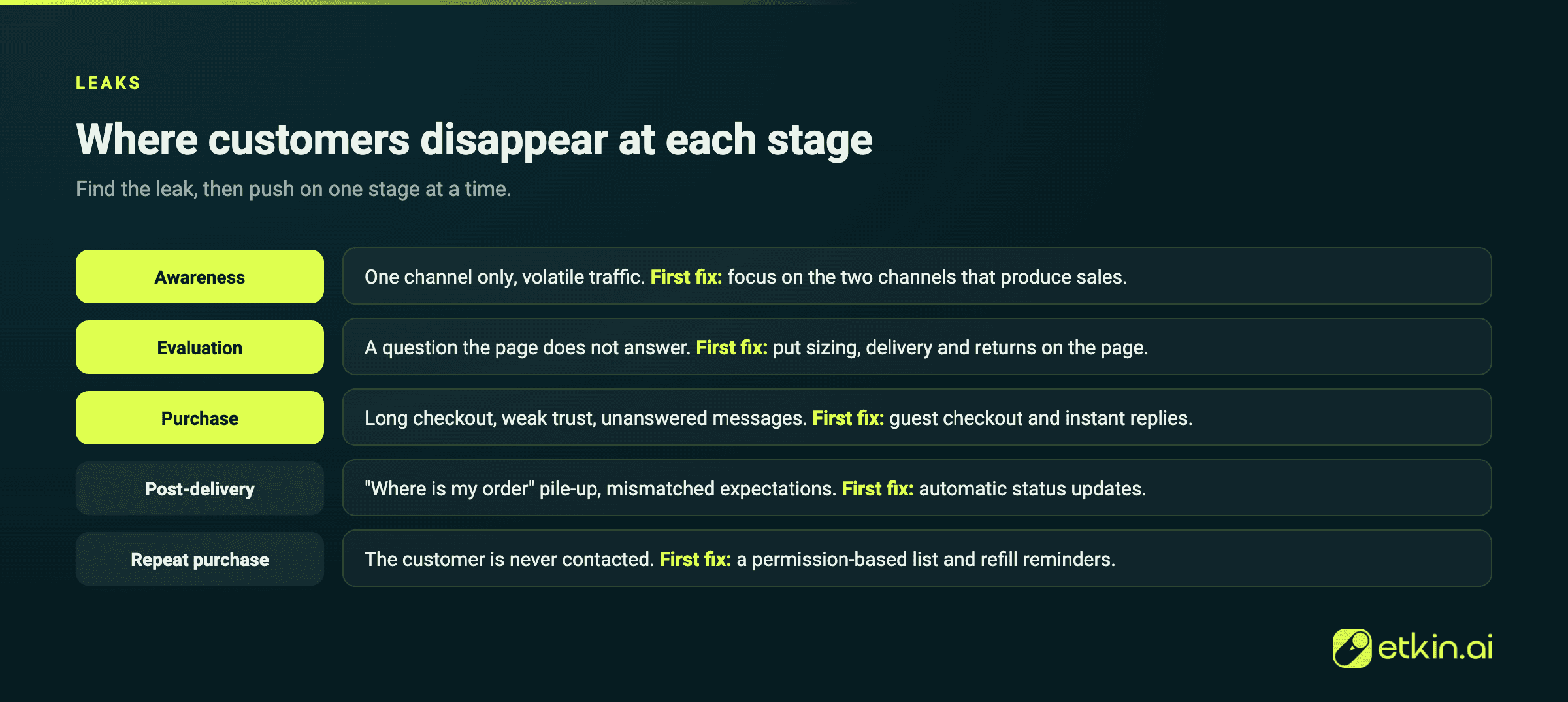
| Stage | The single number | Typical leak | First fix |
|---|---|---|---|
| Awareness | Monthly qualified visits | One channel only, volatile traffic | Focus on the two channels that produce sales |
| Evaluation | Add-to-cart rate among product page viewers | A question the page does not answer | Put sizing, delivery and return terms on the page |
| Purchase | Cart-to-order completion rate | Long checkout, weak trust | Guest checkout, short forms, visible guarantees |
| Post-delivery | Return rate in the first 30 days | "Where is my order" pile-up, mismatched expectations | Automatic status updates, a usage message |
| Repeat purchase | Second order rate within 90 days | The customer is never contacted | A permission-based list and refill reminders |
The moment those five numbers sit in one table, your funnel is built. The rest is maintenance.
Four steps to building it
1. Write the stages around your own business. The five above fit most e-commerce brands, but you may have an extra step: a sample request, sharing measurements, a corporate quote. Write what actually happens, not the funnel from a textbook.
2. Assign one number per stage. A stage you cannot measure sits outside the funnel. If you cannot find a stage's number, set up the measurement first; trying to improve it before that is wasted effort.
3. Calculate the transition rate between stages. The real information is not in the stages themselves, it is in the drop between them. If 1,500 of 10,000 visitors add to cart and 300 order, the sharpest drop is between cart and order.
4. Push on the biggest drop. One stage at a time. Fixing the transition with the highest loss always returns more than slightly improving a stage that already works. The maths behind that is in more traffic or higher conversion.
An example with numbers
Picture a brand with 10,000 monthly visitors:
- 10,000 visits, 1,500 add to cart (15%)
- 1,500 carts, 300 orders (20%)
- 300 orders, 45 returns (15%)
- 36 of 300 customers placed a second order within 90 days (12%)
This brand's biggest loss is between cart and order: 1,200 people put a product in the basket and walk away. Raising traffic by 20% brings 60 extra orders. Lifting cart-to-order from 20% to 25% brings 75 extra orders, and costs no advertising money. Without a funnel, that comparison cannot be made.
Where the funnel bleeds most: between evaluation and purchase
In the field, the sharpest drop is almost always here. The customer liked the product, added it to the basket, and then stopped. The reason is usually not price. It is an unanswered question: "will this fit me", "when will it arrive", "can I return it if I do not like it".
That question goes to one of two places. Either the product page answers it, and the customer reads and buys. Or the customer sends a message. Once they do, everything comes down to response speed. When the reply arrives two hours later, that person has already bought elsewhere, and messages arriving at night or at weekends go unanswered entirely at most brands.
The size of the loss appears once it is measured. At Defne Home, once every message was answered instantly, overnight ones included, 5% of DMs turned directly into orders. At Mervellion, 89% of more than 800 daily DMs were resolved without a human touch, and nothing went unanswered even on the busiest day.
Etkin AI works at exactly this point in the funnel: it connects to the brand's real stock, pricing and order data, answers questions on WhatsApp, Instagram and website chat around the clock, brings back abandoned carts and tries to turn a return request into an exchange. It reduces the drop between evaluation and purchase and the post-delivery leak at the same time.
Keep the funnel alive
A funnel drawn once stops describing reality a few months later. Look at the five numbers weekly from the same place, put the transition rates side by side, and check whether the sharpest drop has moved. If it has, the focus moves with it. To see which stage will crack first as volume grows, read why operations break when sales grow; to audit the areas outside the funnel, use the 30-question growth audit.
Frequently asked questions
Is a sales funnel the same as a customer journey? Close, but not the same. A customer journey describes the experience. A funnel turns that journey into numbers. Its job is not storytelling, it is showing where the loss sits.
How many stages should a funnel have? As many as you can measure. Five is enough for most e-commerce brands. A ten-stage funnel looks impressive on paper and does nothing, because none of the stages get measured regularly.
Should I grow the top of the funnel or the bottom? Fix the transition with the sharpest drop first. Growing the top while the hole at the bottom stays open just pushes more people through the same hole.
Why is repeat purchase part of the funnel? Because most of the profit is there. On the first sale you carry advertising, shipping and return risk together; on the second, most of that is gone. A brand whose funnel ends at the first order is not measuring its most profitable stage.
I am a small brand. Do I need this much measurement? Five numbers fit in one table and take ten minutes a week. When you are small and resources are scarce, pushing in the right place matters even more.
Read next
- The 30-Question E-Commerce Growth Audit
- How to Increase E-Commerce Sales: 25 Proven Methods
- Why Do Operations Break When Sales Grow?
If the biggest drop in your funnel sits between evaluation and purchase, let us show you in 15 minutes how much revenue is slipping away there, using your own channels and your own data. Get started